

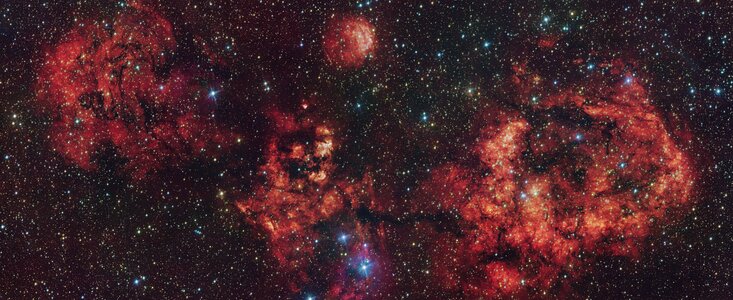
High above the Atacama Desert, a crimson apparition stretches across the night sky. Just in time for Halloween, astronomers at the European Southern Observatory (ESO) have captured a vast cloud of gas and dust shaped like a flying bat, its wings outlined in starlight. The eerie figure, located about 10,000 light-years from Earth, offers both a breathtaking spectacle and a scientific glimpse into the turbulent birth of stars.
The new image, released by ESO, combines visible and infrared light data from two of its telescopes in northern Chile. Using the VLT Survey Telescope (VST) and the Visible and Infrared Survey Telescope for Astronomy (VISTA), scientists assembled a panoramic view that reveals the glowing skeleton of an immense stellar nursery. Red hydrogen gas, excited by the radiation of newborn stars, forms the bat’s bright wings, while darker filaments of dust trace its shadowy bones.
A Halloween Spectacle in Deep Space
The scene looks almost too perfect for coincidence. In the image, the nebula’s wings span an area of the sky roughly equivalent to four full moons. Its main body and right wing correspond to the star-forming regions known as RCW 95 and RCW 94, respectively. The rest of the structure, though unofficially named, completes the unmistakable silhouette of a bat in flight.
“A spooky bat has been spotted flying over the European Southern Observatory’s (ESO’s) Paranal site in Chile, right in time for Halloween,” the observatory reported. “Thanks to its wide field of view, the VLT Survey Telescope (VST) was able to capture this large cloud of cosmic gas and dust, whose mesmerising appearance resembles the silhouette of a bat.”
To the naked eye, such a nebula would be invisible. But through the VST’s 268-megapixel OmegaCAM, which can map huge regions of the Milky Way, the structure comes alive in haunting detail. The telescope, operated by the Italian National Institute for Astrophysics (INAF) and hosted at ESO’s Paranal Observatory, is designed to scan wide swaths of the southern sky with precision and clarity.
In this case, the VST data came from the Photometric H-alpha Survey of the Southern Galactic Plane and Bulge, or VPHAS+. The red glow in the image marks areas where hydrogen atoms are being ionized by ultraviolet light from young, massive stars. Supplementing that, the VISTA telescope added infrared data from the VISTA Variables in the Via Lactea survey, which reveals the hidden structure within the densest parts of the cloud where stars are still forming.
When Light and Dust Conjure a Cosmic Creature
At first glance, the nebula’s contrast of bright and dark regions might look like a Halloween trick of the cosmos. But in reality, it traces the life and death of interstellar material. The darker lanes represent colder, denser gas and dust that block visible light, while the brighter parts are energized zones where stars have already ignited nuclear fusion. It is a scene both violent and creative, where stellar winds and radiation carve intricate shapes into the surrounding medium.
The RCW 94/95 complex sits between the southern constellations Circinus and Norma, in a region teeming with star formation. Its scale and symmetry make it one of the most visually striking nebulae in the Milky Way. The VST’s ability to capture such sweeping features in sharp focus shows how modern astronomical surveys can transform even familiar parts of our galaxy into works of cosmic art.
“This image was pieced together by combining observations through different filters, transparent to different colours or wavelengths of light,” ESO explained. “Most of the bat’s shape, including the red glow, was captured in visible light as part of the VST Photometric Hα Survey of the Southern Galactic Plane and Bulge (VPHAS+). Additional infrared data add a splash of colour in the densest parts of the nebula.”
The result is an image that feels almost alive, a creature stitched from radiation and shadow. To some astronomers, scenes like this highlight the power of storytelling in science: the way a distant gas cloud, when seen through human eyes, can evoke awe and imagination. To others, it is a reminder that beauty and physics often coexist. The same forces that sculpt these cosmic wings are the ones that will one day scatter them, seeding new generations of stars and planets.
For now, though, the cosmic bat remains a symbol of the season and of the Universe’s endless creativity. As ESO playfully concluded in its release, this haunting figure invites us to “dare to look closer, and let your curiosity be haunted by the wonders that await in the dark.”
Source: European Southern Observatory (ESO), Reports and Proceedings, 31 October 2025.