
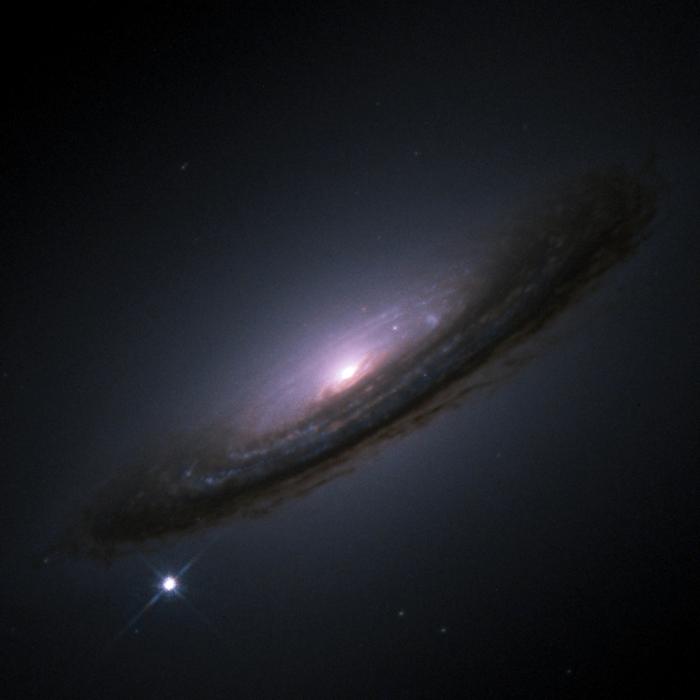
The headline finding is stark enough to stop a cosmologist mid scroll. A new analysis of Type Ia supernova data, corrected for a subtle but powerful age bias, says the universe may already have shifted from accelerating to decelerating expansion. The work, led by researchers at Yonsei University and released with the Royal Astronomical Society, lands today in Monthly Notices of the Royal Astronomical Society and leans into a growing chorus from BAO and CMB measurements that dark energy may be evolving with time.
For a quarter century, the standard story has been cosmic acceleration driven by dark energy, an unknown component that acts like negative gravity. That narrative was built in large part on distances inferred from Type Ia supernovae, treated as standard candles after careful calibration. But the Yonsei team argues that even after the usual standardization, the brightness of these supernovae still drifts with the age of their progenitor stars, which changes with redshift. Younger populations tend to yield slightly fainter standardized explosions, older ones slightly brighter, a population shift that can masquerade as extra cosmic dimming.
Using age measurements for hundreds of host galaxies and a redshift dependent correction, the authors show that the supernova Hubble diagram no longer lines up with the classic Lambda CDM model once this bias is removed. Instead, it aligns more closely with a model in which dark energy’s equation of state varies over time, the same direction favored by BAO and CMB data from the DESI project. In the combined picture, the present day deceleration parameter flips sign toward deceleration, not acceleration.
“Our study shows that the universe has already entered a phase of decelerated expansion at the present epoch and that dark energy evolves with time much more rapidly than previously thought.”
That is a bold claim, and the team does not shy away from the implications. Type Ia supernovae have been the workhorse probe since 1998, the basis of a Nobel Prize in Physics. If part of their apparent dimming at high redshift arises from evolving stellar age rather than purely from cosmic kinematics, then a cornerstone of modern cosmology needs reinforcement. The authors say their correction is anchored in direct galaxy age measurements and in the well studied evolution of the cosmic star formation history, which predicts a younger mix of supernova progenitors at higher redshift.
A Subtle Bias With Outsize Consequences
The technical pivot is specific yet intuitive. Host galaxies grow older as the universe ages. That means the typical progenitor age for a Type Ia supernova is not constant with redshift. If brightness after standardization still correlates with progenitor age, then an unmodeled trend with redshift will enter the supernova Hubble diagram. The Yonsei team quantifies this with a slope of standardized magnitude versus age, then applies a redshift dependent correction across the supernova sample. Before correction, supernova distances weakly support Lambda CDM. After correction, they do not. They instead match a time varying dark energy model that BAO plus CMB already prefer.
Visually, you can imagine the classic Hubble residual plot like a quiet lake at dusk. The uncorrected supernova points ripple away from the Lambda CDM curve in a way that once seemed convincing. Apply the age correction, and the ripples settle toward a different shoreline, the one traced by BAO and CMB in the same cosmological coordinates.
There are immediate knock on effects. First, the apparent new concordance between corrected supernovae, BAO, and CMB strengthens the case that the cosmological constant is an imperfect description of dark energy. Second, the present epoch may not be accelerating at all, which dramatically reframes timelines about the ultimate fate of the cosmos. Third, age linked systematics might contribute to the Hubble tension by subtly shifting distance ladder rungs if calibrator hosts and Hubble flow hosts do not match in progenitor age.
“If these results are confirmed, it would mark a major paradigm shift in cosmology since the discovery of dark energy 27 years ago.”
What Comes Next, And How To Falsify It
Extraordinary claims invite austere tests. The team has already launched what they call an evolution free test, selecting only supernovae from comparably young, coeval host galaxies across the full redshift range, which should neutralize the age bias without any model dependence. Early results point the same way. The decisive experiment may soon come from the Vera C. Rubin Observatory, now in survey mode in Chile, which is expected to deliver tens of thousands of new supernova host galaxies. With that flood of data, researchers will be able to measure host ages directly, reduce uncertainties on the age bias slope, and stratify samples so that cosmology is not entangled with stellar population drift.
For now, the safest interpretation is not that dark energy has disappeared, but that it may be dynamic, and that our favorite cosmic candles sometimes flicker with their birth certificate. The field has seen sharp turns before. What separates a surprise from a revolution is replication with independent data and analyses. If the BAO and CMB drumbeat continues, and supernova cosmology keeps time after age aware corrections, the soundtrack of the universe’s expansion history could shift key, from accelerando to ritardando, already in the present day.
Monthly Notices of the Royal Astronomical Society: 10.1093/mnras/staf1685
Discover more from European Space Agency Tracker
Subscribe to get the latest posts sent to your email.