

Experience tells us that it is much easier to extend median lifespan than maximum lifespan. Katcher’s trial of E5 in 8 rats breaks this expectation. The last of Harold Katcher’s rats has died, and she outlived her sisters by 7 months. Compared to controls, the average lifespan of treated rats increased 9.6%, while the maximum lifespan increased 22.0%. (For reasons unknown, the control rats lived longer than most Sprague-Dawley rats.)
When I last wrote about Katcher’s rats, there were just two left alive, and the survival curve conformed well to the Gompertz rule, which says that mortality rates increase exponentially with age. (There is no theoretical basis for the Gompertz rule, but it has been found to be a good empirical model for aging in many species.) From a Gompertz fit to the first 6 rats, I was projecting a maximum lifespan of 1250 days. The 7th rat wasn’t far off from that estimate, but the last of the 8 has lived just over 4 years (1464 days), breaking the record for lab rats. “Sima” lived 5% longer than the previous longest-lived Sprague-Dawley rat.
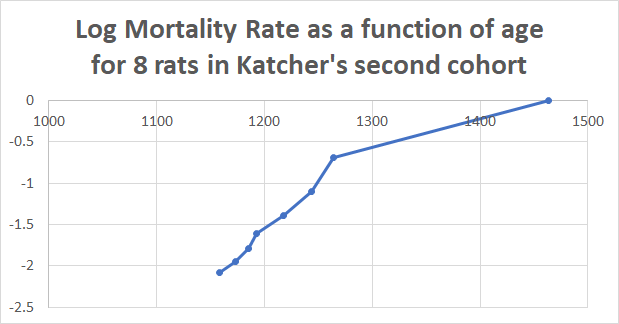
Sima received five infusions during her lifetime at intervals of 3 months. A sixth scheduled treatment was held on the judgment of the experimenters, so that at Sima’s death she was more than six months out from her last infusion. The fact that one rat lived longer than the rest is an invitation to experiment with optimization of the E5 protocol. All the rats were genetically identical and raised in the same lab. All received their first treatment around 2 years of age. Perhaps there are physiological tests that would offer suggestions why Sima responded better to the treatment.
Where does this project need to go?
It has been almost three years since I wrote up (breathlessly) the results of Katcher’s first study. I called it an Age Reduction Breakthrough. I still believe that plasma transfusions are the most promising path toward real, practical rejuvenation in the near-term. It is frustrating how little has happened in the intervening years. This should be a crash project for laboratories around the world, and instead it is being confined to a small group of scientists in Mumbai and Baltimore who are holding the IP.
Edison invented the lightbulb in 1879, and the first commercial units went on sale to the public in 1880.
We all should be demanding of Katcher and Sanghavi and our funding agencies a full-scale research program.
- Determining what are the essential ingredients in E5 (Our patent system provides perverse incentives NOT to do this.)
- Developing synthetic methods for creating these proteins (perhaps with vats of genetically modified E coli, a method which provides insulin and other human proteins in bulk at extremely low cost).
- Adding plasma dilution to the protocol of infusions
- Experimenting with different schedules and dosages, using Horvath clocks for feedback
- Following all this up with lifespan studies in several mammalian species
- Simultaneously offering E5 in combination with plasma dilution to human volunteers who are eager to be experimental subjects in exchange for probability of substantial health benefits.
Katcher and Sanghavi have a company called Yuvan Research, and they have connections with a laboratory at Johns Hopkins University in Baltimore. But this program is moving much more slowly than I would like (perhaps you concur) because the resources they have available are limited and Yuvan is jealously guarding its intellectual property. It didn’t help that Yuvan’s working capital was parked with Silicon Valley Bank, which went belly-up on Friday.
I suspect that many partners for Yuvan are available worldwide if suitable legal agreements can be reached.
Discussion
45 reader comments
Imported threads are marked Archive. New comments are welcome and moderated for spam.
I find it a little disconcerting that neither Harold or Akshay seem to be commenting or participating in discussions any longer. They have also not given an update since February. I hope all is well with them and their research as I feel it is the most promising treatment on the horizon.
reCaptcha test
Josh, have you seen this? https://www.nature.com/articles/s41591-023-02296-6 Although not about E5 this research seems that it can only further establish the viability of Harold’s work. “Here we find that an organ’s biological age selectively influences the aging of other organ systems, revealing a multiorgan aging network.”
At the end of that paper's Discussion section is:
"Due to the sequential and non-randomized participant assessment schedule, we were unable to assess the influence of brain aging on body systems."
From Dr. Katcher's 2015 "Towards an Evidence-based Model of Aging":
"It was demonstrated that increased aging occurred as a result of lack of gonadotropin-releasing hormone, and that increased lifespan resulted from its provision during aging. In this manner:
Aging of hypothalamic microglia leads to
Aging of the hypothalamus, which leads to
Aging elsewhere in the body.
So here we have a multi-level interaction:
Activation of NF-κB leads to
Cellular aging, leading to
Diminished production of GnRH, which then
Acts (through cells with a receptor for it, or indirectly as a result of changes to GnRH-receptor-possessing cells) to decrease lifespan.
So the age state of hypothalamic cells, at least with respect to NF-κB activation, is communicated to other cells via the reduced output of GnRH.”
Not using the same frameworks/paradigms, are they? But maybe through their limitations statements, those researchers at least know what's the way forward.
@PRice, My comment was intentionally short to make it easier to deal with and more likely I would get a reply, but I think I should be more specific. I’ll preface this by saying I think both of your points are good and I really appreciated the time you spent responding to my comment. I was mainly concerned with a third thing.
When validating a scientific hypothesis like Dr.Katcher’s theory of aging we’re talking about reproducibility of all of it’s elements and also how the body of supporting evidence from independent experiments effects the status quo. Namely, that even though it only serves to validate a relatively small proportion of the relevant facts, that aging of different organs are connected instead of merely coinciding in some sense, it happens that this is a particularly useful fact to validate.
It’s particularly useful because of the mechanisms and status quo of the politics of science and to some extent public opinion. As Harold and Akshay continue to do research and to give their research the best chance of making an impact on human health there are a range of scenarios that they could face, ranging from incredible funding and public support to great resistance and even legal, financial and for Harold potentially even longevity barriers if those obstacles take too long to traverse. There is also the matter of some people who may end up dying or suffering other serious consequences waiting for it. Of course, the reality will probably be somewhere in the middle, and since his work isn’t that well known yet we don’t know how much support and opposition he’ll really get.
In my view, at least on the opposition side of the ledger the biggest risk comes from substantially different opinions in certain parts of the scientific community. I’m not talking about constructive criticism or pointing out a few things that can be addressed in the existing experiments or published theory and methods, I’m talking about opposition, not simple concerns, on the basis of things that no one has tested yet. Some of it may come from scientists with a competing theory, but I think the strongest opposition would likely come from people who don’t think science has advanced enough to even have a theory of aging. If we think of these opinions on aging roughly fitting into distinct categories, I would suppose that the opposition would come less from people in the same category and more from people with highly differentiated categories of opinions.
That’s why I think it’s particularly useful to validate this particular fact, since this research weighs in favor of the fact that is part of the 10,000 foot view of Harold’s work. I think fewer people from other categories will feel confident to criticize the details of Harold’s proposed mechanism and so this type of research can make a bigger impact on E5 research at this stage than many other things.
another view
aging is caused by the imbalance in the number of differentiated cells VS stem cells. It is because of the fast growth of the differentiated cells during the growth phase, the epigenetic curve shows a vertical slope , which gradually changes as the differentiated cells numbers grow. eventually growth stops and aging commences as it is the property of the differentiated cells to age epigenetically. The mere presence of differentiated cells in sufficient numbers tamps down the activity of the stem cells.
The factors in the plasma which allow stem cells to be activated and increase in numbers are the ones which need to be identified and are probably the solution. The balance of stem cells and differentiated cells needs to be restored to reverse aging.
dwarfism is a condition which bestows many benefits to an individual, such as decelerated pace of aging. IMO the condition of dwarfism allows the balance of stem cells and differentiated cells to be favorable for a longer period of time because of lesser number of differentiated cells.
Also IMO human females who are smaller in size than the males have a lesser burden of disease because of this very reason.
autophagy-dependent cell death mechanism might be activated during starvation/calorie restriction as well as stem cell stimulation. both these mechanisms alter the balance of stem cell/differentiated cells.
Whereas intake of HGH/testosterone in the aged might lead to extended division/survival of differentiated cells again altering the balance of stem cell/differentiated cells, which can be pro-aging.
Thank you Josh for pointing out the obvious: this is a massively important area of research, and the lack of progress and funding here is frustrating.
Yes I agree why is this progressing so slowly? It's really very frustrating.
Quite predictably, given that the basis of plasma are extracellular vesicles https://en.longevitywiki.org/wiki/Extracellular_vesicles
Nice draft, thanks for sharing.
Anecdote: a friend of mine, a top-level professional football (soccer) athlete, suffered an ankle injury when he was 35, i.e. close to the end of his professional career. He decided to try a treatment with stem cells-derived extracellular vesicles that included liposuction and, after isolation/cultivation, re-infusion in his arm. This not only cured his ankle in a record time but also had an important systemic effect on his whole body that allowed him to compete a few more years at the top level.
"...There is no theoretical basis for the Gompertz rule, but it has been found to be a good empirical model for aging in many species..."
It looks like there might be theoretical basis to Gompertz, e.g. I found this, from Uri Alon and team, an interesting conjecture:
"A causal factor in mammalian aging is the accumulation of senescent cells (SnCs). SnCs cause chronic inflammation, and removing SnCs decelerates aging in mice. Despite their importance, turnover rates of SnCs are unknown, and their connection to aging dynamics is unclear. Here we use longitudinal SnC measurements and induction experiments to show that SnCs turn over rapidly in young mice, with a half-life of days, but slow their own removal rate to a half-life of weeks in old mice. This leads to a critical-slowing-down that generates persistent SnC fluctuations. We further demonstrate that a mathematical model, in which death occurs when fluctuating SnCs cross a threshold, quantitatively recapitulates the Gompertz law of mortality in mice and humans. The model can go beyond SnCs to explain the
effects of lifespan-modulating interventions in Drosophila and C. elegans, including scaling of survival-curves and rapid effects of dietary shifts on mortality."
sorry .. forgot to link to the DOI: https://doi.org/10.1038/s41467-019-13192-4
Interesting. I wonder if studies have been done on non-mammals to see how much lower the accumalation of senescent cells are. I guess some researchers argue the high senescent cell burden as we age actually helped mammals adapt better in some ways.
I agree. I think mammals and especially humans possess characteristics that increase the need for senescence relative to other organisms.
Great comments Josh. Its tragic that we likely stand on the threshold of a breakthrough which excites our imagination and would add hope to the lives of literally billions of people around the world, but are held back not by fundamental technology but by the nature of human society. Huge numbers of people are dying who very well might not need to.
I suppose we need an angel investor who themselves want to bring this boon to humanity (and themselves) and are sufficiently willing to share the profits (and all of the credit) with Yuvan. It seems likely that there should be a large number of people with the kind of resources that could do this. Finding that person and convincing them has been achieved for lesser objectives in the past. It’s not clear to me why it’s not possible now.
Maybe E5 will no longer be needed, after all!
Kurzweil's book "The Singularity is Near Part-2" is out. And as I understand, he claims that by 2030 all deceases of age will be curable at the cellular level using nanobots. So all we need to do is extend our lives to about 2030 in reasonably good health.
https://lifeboat.com/blog/2023/03/ray-kurzweil-says-well-reach-immortality-by-2030-the-singularity-is-near
It's not out til june, is it?
Not sure when.
But I was just joking, anyway :-)
Even if it becomes scientifically possible by 2030, by the time it gets FDA approvals and it reaches the general public, it will be 2040 or beyond. So, our best bet is still E5.
please his predictions a joke
I guess you have seen Josh's comment on the Lifeboat blog:
"There are some things Kurzweil understands brilliantly. Aging is not one of them. Aging is not a cellular disease, it’s a systemic disease."
Actually, I had not read the comments at Lifeboat, so I was not aware of Josh's comment when I posted here. As I have been following this blog for a long time, I have been aware of Josh's thinking, which makes a lot of sense of me. As a result, I consider E5 to be the "smart way" to address the aging problem.
Of course, being able to solve the problem "smartly" does not preclude the possibility of addressing the same problem by "brute force" at the cellular level as Kurzweil suggests. Kurzweil has a good record with predicting future developments. His prediction that solving the problem of aging at the cellular level in the thirties might be possible at the lab. It is very unlikely that it will be available to the general public in that time frame.
I strongly believe that "E5" is now the best bet. Hopefully it will be available much sooner.
With my initial comment that we might no longer need "E5" I was trying to be funny.
Sam Altman recently invested Retro Biosciences about 180 million. Seems like they are taking blood plasma as one of the important avenues to look into for rejuvination.
Full article here:
https://www.technologyreview.com/2023/03/08/1069523/sam-altman-investment-180-million-retro-biosciences-longevity-death/
I think they will move at silicon valley startup speed And competition may be good for the consumer.
Dummy post to receive comments