

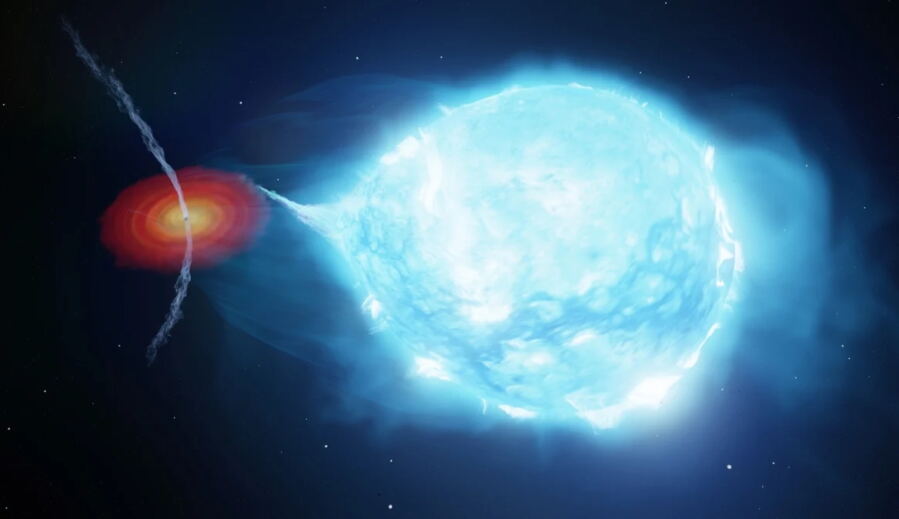
For eighteen years, radio telescopes have been staring at the same small patch of sky in the constellation Cygnus, watching a black hole do something that black holes do rather well: devour its companion star and fling what it can’t swallow back into the universe at half the speed of light. The watching has been patient, meticulous, and until very recently, frustrating. The jets blazing outward from the black hole known as Cygnus X-1 were obviously powerful. How powerful, exactly, remained stubbornly out of reach. The telescopes could see the output. They just couldn’t measure it.
Now they can. An international team drawing on nearly two decades of archival radio data has produced the first direct, instantaneous measurement of a black hole jet’s power, confirming a theoretical prediction made a decade ago by astronomers at the University of Wisconsin-Madison and settling a number that cosmologists have long had to simply assume when they model how galaxies form.
A Dancing Jet and a Useful Accident of Geometry
Cygnus X-1 sits roughly 6,000 light-years away and is about as convenient a laboratory as astrophysics offers. Its black hole, weighing in at around 21 times the mass of our Sun, orbits a supergiant companion star every five and a half days. The star bleeds constantly, shedding mass through a dense stellar wind. Some of that wind falls onto the black hole; the rest slams into a pair of particle jets that punch outward perpendicular to the black hole’s spin axis. The jets are moving at around 150,000 kilometers per second. The wind is not. So the wind bends the jets, pushing them off-axis like a garden hose caught in a gale, and the bending angle tells you something important about the balance of forces involved.
In 2015, Sebastian Heinz, a professor of astronomy at UW-Madison, and then-graduate student DooSoo Yoon built simulations predicting precisely this dynamic: that stellar winds in these kinds of binary systems should bend the jets in ways that could, in principle, let you calculate the jet’s power from first principles, no assumptions required. “This basically confirms our predictions,” Heinz says now. “It’s not often that you get to do that in science, especially in astronomy, because you have to wait for the universe to align. That can take a while.”
The new measurements used two continent-sized networks of radio telescopes, the Very Long Baseline Array in North America and the European VLBI Network, capable of resolving detail equivalent to reading a newspaper from across a continent. The team watched Cygnus X-1 through one complete binary orbit in 2016 and then went back through eighteen years of archival observations to check whether the bending was consistent. It was, orbital phase after orbital phase, year after year.
The Measurement the Field Has Been Waiting For
Steve Prabu, a Breakthrough Listen Fellow at the University of Oxford and the study’s lead author, describes piecing together the jets’ motion from all those observations: “We were able to piece together the ‘dancing’ motion of the jet and measure its properties in a way that hadn’t been possible before. By doing so, we discovered that the stellar wind from the companion star is strong enough to bend the jet, and this gave us a unique way to measure the jet’s power directly.”
The figure they arrived at is striking. Cygnus X-1’s jets are pouring out energy at a rate equivalent to about 10,000 times the total output of our Sun. Not over the black hole’s lifetime, not averaged across millennia. Right now, or as close to right now as anything 6,000 light-years away can mean. Previous estimates had to be derived from the enormous bubbles and cavities the jets carve into surrounding gas clouds over thousands of years, which gives you something like a lifetime average but cannot tell you what the jets are doing at any particular moment. The new measurement, by contrast, reflects conditions within roughly an hour of the jet leaving the black hole itself. The two approaches, gratifyingly, agree with each other.
That agreement matters rather a lot for physics beyond this one system. Galaxy formation simulations (the big cosmological ones, like IllustrisTNG and SIMBA) need a number for how efficiently accreting black holes convert infalling matter into jet energy. Without a real measurement, modelers have had to tune this parameter by hand until the simulated universe looks vaguely like the real one. “This is an important anchor point,” Heinz says. “If we can build an understanding of the relationship between what’s falling into the black hole and what goes into the jet, we will be able to describe the effect the black holes can have, through their jets, on what is happening even far off from the black hole.”
Holes Punched Through Gas, and Why That Matters
Jets from black holes are not passive. They drill through clouds of gas, seed the interstellar medium with magnetic fields and high-energy particles, generate large-scale turbulence, and excavate enormous cavities in galaxy clusters large enough that entire galaxies could fit comfortably inside. Over millions of years, the total kinetic energy dumped into a galaxy’s environment by its central black hole rivals, on some estimates, the energy released by a supernova. Whether galaxy clusters stay hot or collapse to form new stars depends critically on that energy budget. “We know these jets probably have very energetic particles in them,” Heinz says. “We can see where they have poked holes right through things, like clouds of gas. But to understand how they can shape the universe around them, we need to know just how powerful they are.”
The study also weighed in, somewhat incidentally, on a separate debate about whether Cygnus X-1’s jet is misaligned with the black hole’s orbital plane. Recent X-ray polarization measurements had suggested a substantial tilt of 20 degrees or more, which would have implied a significant kick at the moment the black hole formed. The bending data point the other way: the jets appear to be well-aligned with the binary orbit, within about eight degrees, consistent with a black hole that formed quietly, by direct collapse, without much of a natal shove.
The caveat is real and worth noting. Cygnus X-1 is a particular kind of system, one with a convenient nearby star to do the bending. Not every black hole binary has that geometry. Extending this technique to quieter, more isolated systems, let alone to the supermassive black holes sitting at the hearts of distant galaxies, remains a challenge that the current measurement does not solve. What it does do is validate, for the first time, the conversion efficiency that cosmological simulations have been using for years. The assumed number turns out to be roughly right.
Which means that all those virtual galaxies, slowly shaped over simulated billions of years by simulated black hole jets, have been growing up in something closer to the right conditions than we had any right to assume. The universe, as it turns out, is at least a little bit obliging about confirming our guesses, provided you’re willing to stare at it long enough.
The research was published in Nature Astronomy: https://doi.org/10.1038/s41550-026-02828-3
Frequently Asked Questions
Why is it so hard to measure the power of a black hole’s jets?
Jets produce featureless synchrotron radiation that doesn’t directly reveal how much energy they’re carrying. Previous estimates relied on the size of cavities the jets had carved in surrounding gas over thousands of years, which gives a kind of lifetime average but can’t capture what the jets are doing at any given moment. The new approach uses the physical bending of the jet by a companion star’s wind, which is governed by a direct force balance and reflects current conditions rather than a geological record of past activity.
Could this technique work for other black holes, including supermassive ones?
For now, it requires a specific setup: a black hole in a close binary orbit with a massive companion star whose wind is strong enough to visibly deflect the jet. Cygnus X-1 is particularly well-suited. Extending the method to supermassive black holes at galactic centers, which lack such a companion, would require finding analogous structures that could act as a known force against the jet, which remains an open problem. But the Cygnus X-1 measurement at least validates the energy conversion fractions assumed in galaxy-scale simulations.
What does jet power have to do with how galaxies form?
Jets from accreting black holes are one of the main ways energy gets pumped back into the gas that would otherwise cool and collapse into new stars. If the jets are too weak, galaxy clusters collapse and form stars too quickly; if too strong, they overheat their surroundings. Cosmological simulations have to tune the efficiency of this energy injection to reproduce the universe we see, and they’ve been doing so with an assumed number. The Cygnus X-1 measurement shows that assumed number is in the right territory, grounding decades of simulation work in an actual observation.
Is Cygnus X-1 typical of black holes generally?
It’s a well-studied system, but not entirely typical. At about 21 solar masses, the black hole is relatively massive for a stellar remnant, and the companion is an unusually luminous supergiant. The closely orbiting pair make it easier to detect effects like jet bending that would be invisible in more isolated systems. That said, the physics of jet formation is thought to be scale-invariant across many orders of magnitude in black hole mass, which is why a measurement here has implications for everything from stellar-mass binaries to quasars.