Every spring, the same headline goes around the world: Finland is the happiest country on Earth. In the latest World Happiness Report, it took the top spot for the ninth year in a row. You’ve probably seen it.
That ranking comes from a single question. People imagine a ladder, from 0 (the worst possible life for them) to 10 (the best), and say which step they’re on. It’s a good question. But you can put yourself on a solid seven and still wake up exhausted every morning. You can have wonderful friends and be worried about rent.
And then there’s money, the question everyone asks sooner or later: does money buy happiness?
For years, the answer you’d hear was a number. A 2010 study by Daniel Kahneman and Angus Deaton suggested that day-to-day happiness stopped rising at around $75,000 a year. Later work disagreed, and in 2023 the researchers on both sides looked at the data together. Their answer was that for most people, happiness kept rising with income, and it only flattened out for the least happy.
A happiness score can’t tell you how you’re really doing
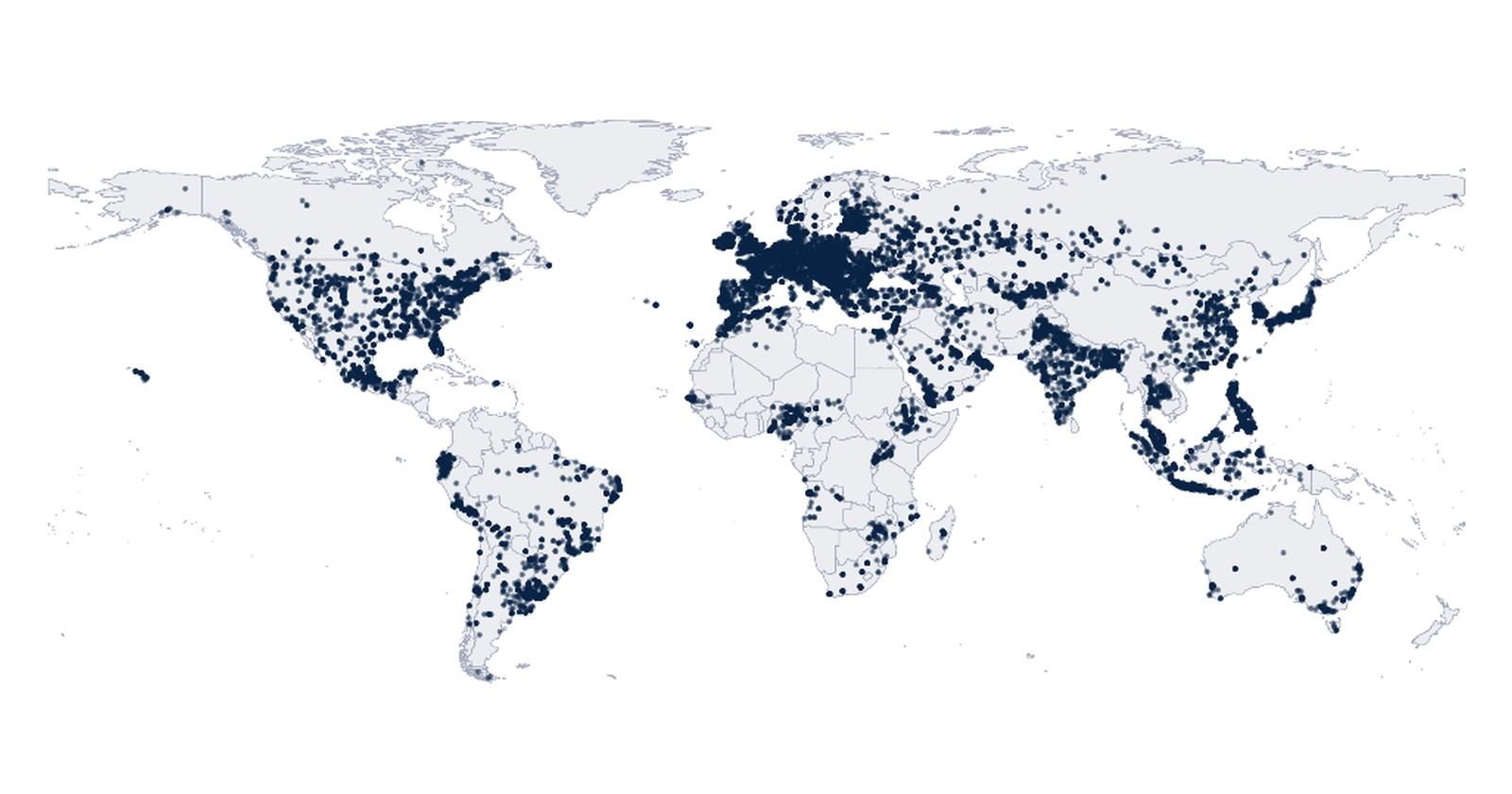
Now a new study tries to look at all of it at once. It’s called “Global mental wealth”, and it asked nearly 54,000 people in 92 countries not one question but ten: about energy, calm, relationships, meaning and more, plus questions about their income, savings, debts and the money they grew up with.
To give you a sense of scale: the last time these ten questions were asked across many countries was in 2012, in 21 European countries. The lead author of that study was Kai Ruggeri, a professor of health policy and management at Columbia University. This time, he went back to it on a much bigger scale: 92 countries, 50 languages and 261 researchers.
It’s a huge piece of work, and it has been accepted for publication in the journal Social Indicators Research. I’d bet these numbers will be quoted a lot once the final version is out. Before that happens, I asked Ruggeri what the results actually say.
I didn’t have to look far to ask. I’m one of the study’s 261 authors (number 126, so not exactly the headline name), and I helped bring the survey to Georgia, where I’m from. I’d also worked with Kai before, on a 61-country study of how people make financial decisions, published in Nature Human Behaviour. But before we get to his answers, here’s what all those people were actually asked.
Ten questions, 50 languages, one awkward word
The core of the survey is ten short statements (all ten are listed in the paper), rated from 1 to 7.
- “I feel full of energy.”
- “I receive help and support from people I am close to when I need it.”
- “I feel what I do in my life is valuable and worthwhile.”
Between June and August 2025, people answered them, mostly online, in 113 versions across 50 languages.
Among 261 authors, three of us adapted the survey for Georgia, and I have to admit, even simple words needed so much work. To give you one example, the Georgian word for “household” isn’t one people really use, so our version asks about your family instead, with “household” in brackets.
Across all countries, the highest-scoring statement was the one about support from close people (5.05 out of 7), followed by meaning (4.93). The lowest was energy (4.20), as in “I feel full of energy.” Even that lowest score is above the middle of the scale, so it doesn’t mean people are miserable. But only about one in five people gave their energy top marks, against nearly two in five for their relationships.
That’s also why one number can hide so much.
In our data, Denmark and Norway gave exactly the same life satisfaction score (6.2), yet their profiles across the ten measures looked clearly different.
Why does my own life look better than the world?

The authors read that pattern as people feeling fairly positive about their own lives while worrying about things outside their control, like political and economic instability. The survey doesn’t ask about society directly, so this is mostly interpretation. I asked Ruggeri what could be behind it.
“It is somehow equally compelling and unsurprising that people largely view their own circumstances as more positive than society at large,” he told me. “Generally, it relates to the idea of control and perception: whether my personal situation is ideal or suffering, I have some ability to impact it, and I am acutely aware of all aspects – good and bad. For society, I mostly am an observer of outcomes.”
And then he gave the example I keep thinking about: “when a company lays off 1,000 people, it makes the news; but if a company hires 1,000 over a one-year period, that is less likely to get noticed.”
It’s such a simple example, and it explains a lot.
Young adults came out lowest. Is it age, or this generation?
You might expect the usual story, where life satisfaction dips in middle age and climbs back up later.
The study found no such U-shape. Instead, young adults scored lowest, and well-being mostly rose with age.
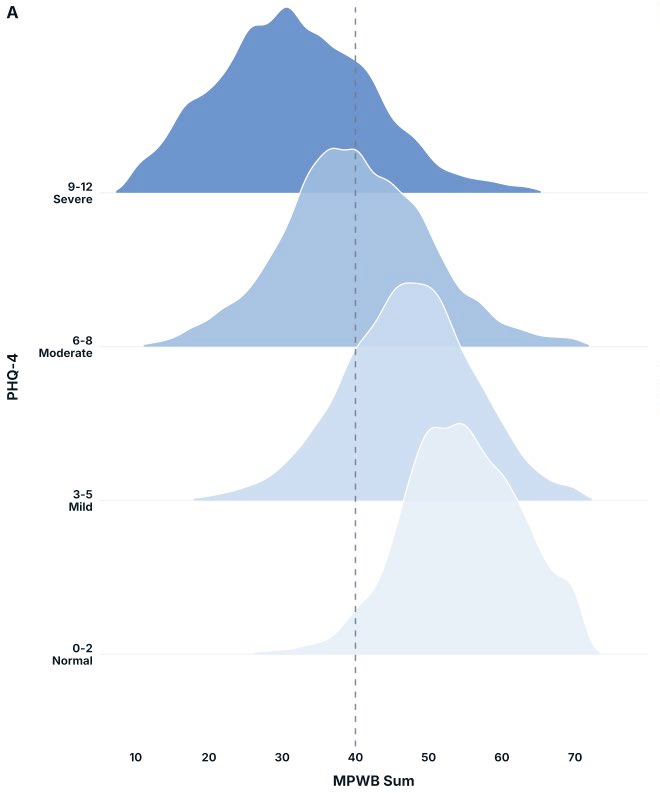
On a short screening questionnaire, only 14.7% of 18- to 25-year-olds showed no signs of depression or anxiety, compared with 23.6% of everyone. That gap is hard to ignore.
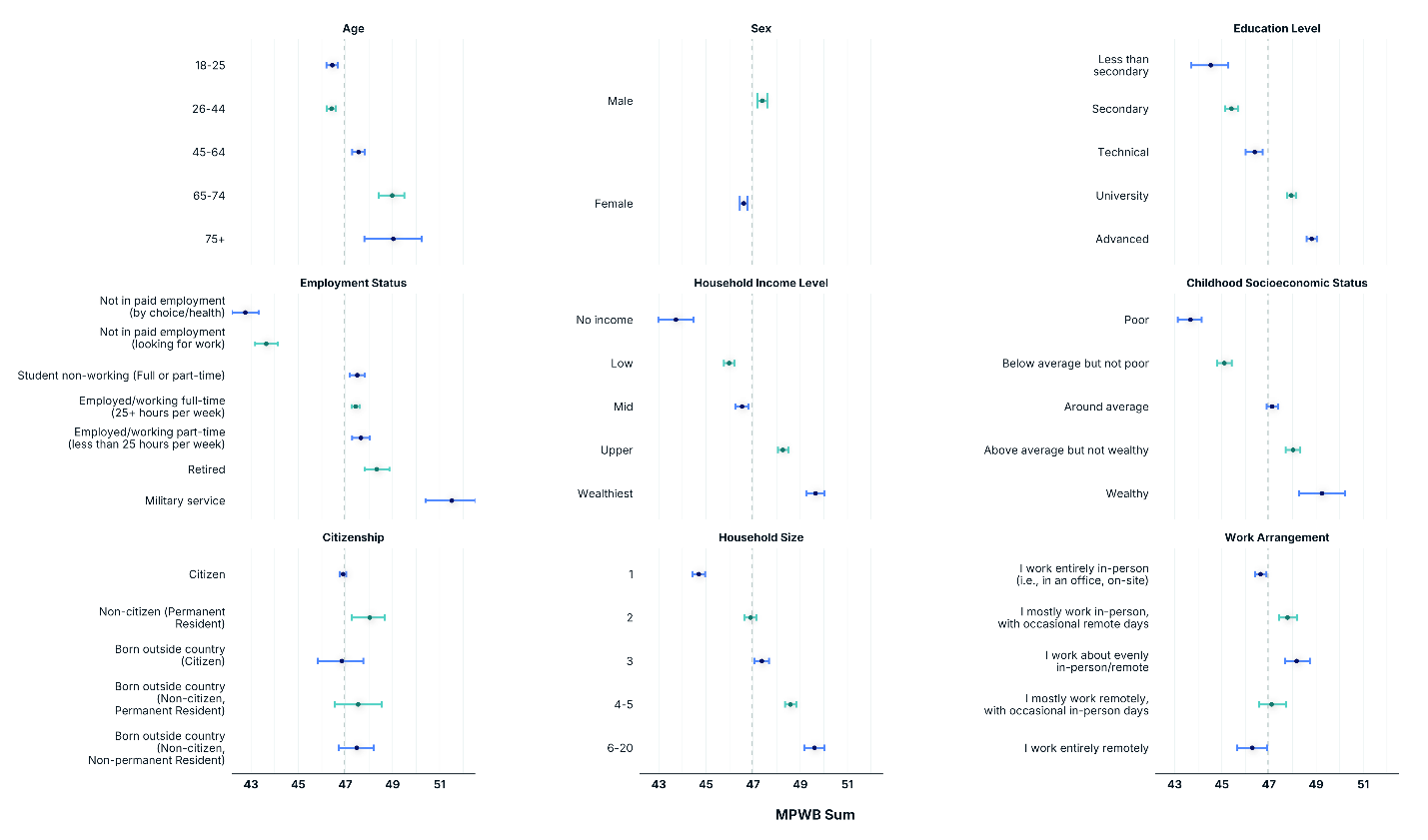
The paper also notes that retirees now score about as well as working adults and students in most countries, which wasn’t the case in 2012. I asked Ruggeri whether that’s about age or about this generation.
“What’s far more concerning is just how widespread the low scores for young adults is,” he said. He listed a few possible reasons, from young people being “overburdened and given limited space to develop at their own pace” to social media and “extreme/perpetual peer comparisons.” Then he pointed to one thing in particular: “Our own data mainly points toward future outlook: messaging toward young people, especially in the face of AI advances, implies careers and economic opportunities are going away, whereas future outlook used to be a primary driver of positive mental health in young people.”
More money helps, but each step buys less
On money, the study found something a little uncomfortable: well-being kept rising with income, with no clear point where more money stopped helping. So I asked Ruggeri what that means for someone choosing between a higher salary and more free time.
He was careful. “There are major differences between economic groups,” he said, so people under more financial pressure probably need more money to reach their happiest point, while for higher earners “the marginal gain… may be generally less, even if it continues.” Going from no income to an average income, and from average to above-average, has big effects on mental health, he explained. Going from very wealthy to extremely wealthy may still help a little, but it takes a much bigger jump in money for a smaller gain.
Here my own small part of the study comes back in. The funniest part of translating the survey turned out to be the money.
The English version asked people for their household income for the year, in brackets that went all the way up to “Over $200,000”. In Georgia, nobody thinks about income per year, so we switched to monthly. And then we had to shrink the numbers. A lot. Our top box ended up as “over 4,000 GEL” a month. That’s about $17,500 a year at the 2025 average exchange rate, which would land you in the second-lowest box of the American version.
That’s not a typo. So when Kai says the first steps up the income ladder matter most, I think of those brackets. For most people back home, those are still the steps that count.
What you can, and can’t, take from the numbers
If you want to look around yourself, there’s a public Global Mental Wealth dashboard where you can explore the results by country and group. It was built by Sofia Pelica, a PhD candidate in psychology at Vrije Universiteit Amsterdam and the study’s second contact author. Ruggeri’s advice is worth reading before you do.
“Those data are meant for general patterns – definitely explore those!” he said. “But it’s most critical never to infer any specific finding.” His recommendation: “only note and take away the general, high-level patterns. But avoid any specific country or group comparisons.”
The result that surprised me most was Georgia’s, maybe because it’s my own country and I know it from the inside. In the paper, it had the highest share of people above the depression screening cutoff, 46.72%. But Ruggeri’s advice applies to me too. The sample was recruited mostly online and through the research teams’ own networks, so it isn’t representative of any country. The questions were answered in 50 languages, and a short screen flags symptoms, it doesn’t diagnose anyone.
Mental health is not just the absence of illness
My last question to Ruggeri was a bigger one: what do we, as a society, get most wrong when we talk about mental wealth and well-being? Here’s how his answer began.
“We say ‘mental health’ but we mean ‘mental illness’. Some might think that’s just semantics, but it genuinely matters,” he told me. When the conversation shifts to depression, anxiety and other conditions, “it almost universally shifts to treatment, whether it’s clinical, pharmaceutical, or institutional.” That narrows what we think we can do, and it mixes up grief tied to a sudden event with long-term conditions like clinical depression. What mental health should mean, he said, is “having a sense of purpose, having good quality relationships, feeling like what we achieve matters.”
“These cannot be solved by yoga and meditation nor by medicine (alone).” — Kai Ruggeri, Columbia University
The data shows this too. People with no signs of depression or anxiety still varied a lot in how well they were doing, and plenty of them scored fairly low.
This isn’t only about how we talk. For decades, psychology itself focused mostly on what goes wrong with people. That’s why, in 2000, Martin Seligman and Mihaly Csikszentmihalyi called for a “positive psychology”: a science of what makes life worth living.
We do the same with resilience. We tend to look for it only in the hard times, as if people need something terrible to happen before they find out how strong they are. But you don’t need a crisis to ask how quickly someone bounces back. One of the survey’s ten statements does exactly that.
Maybe the better question isn’t what people have survived. It’s what gets them out of bed on a normal Monday morning.
There’s much more in this study than I could fit here, and the final paper should be out soon. I’m sure I’ll get back to this conversation. Until then, I hope the next time someone asks how you are, you think about it for a second longer before saying “fine”. I’ll be over here, trying to do the same.