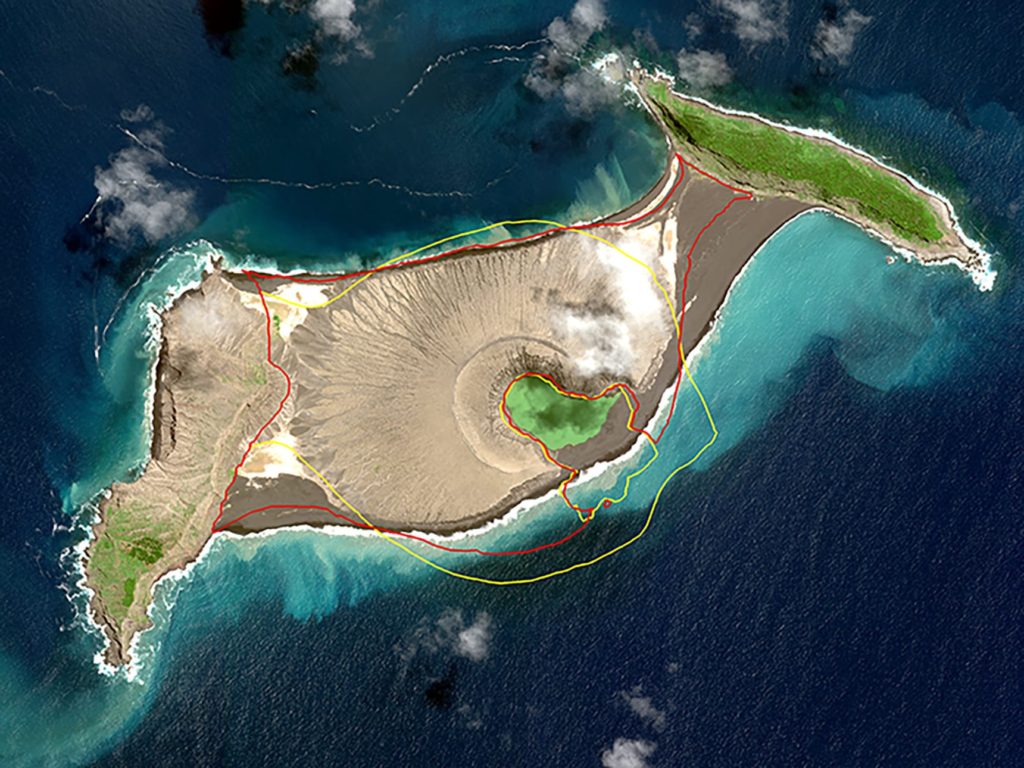
Every so often, the planet does something that atmospheric scientists have been theorising about for decades but have never quite seen happen. On 15 January 2022, in the South Pacific, one of those events took place. A submarine volcano called Hunga Tonga-Hunga Ha’apai, sitting about a hundred and fifty metres below sea level in the Kingdom of Tonga, produced an explosion so violent that it registered on pressure sensors on the other side of the world. The eruption sent an ash plume roughly fifty-seven kilometres into the sky, which is higher than any volcanic plume ever recorded by satellite. It generated a shock wave that circled the globe multiple times. It triggered a Pacific-wide tsunami. And, in what turned out to be the most consequential part of the whole event, it fired an enormous quantity of water vapour into the stratosphere.
Volcanoes normally send sulphur dioxide into the stratosphere. That’s what most of the classic volcanic-climate effects are built around. The sulphur combines with atmospheric water to form sulphate aerosols, which reflect sunlight, and the planet cools slightly for a year or two afterwards. Mount Pinatubo did this in 1991. Krakatoa did it in 1883. Most large eruptions produce a small brief cooling on this mechanism.
Hunga Tonga didn’t. What it produced was water.
What the satellites actually measured
According to a 2022 paper by Dr Luis Millán and colleagues at NASA’s Jet Propulsion Laboratory in Pasadena, published in Geophysical Research Letters under the title “The Hunga Tonga-Hunga Ha’apai Hydration of the Stratosphere”, the Microwave Limb Sounder instrument on NASA’s Aura satellite began picking up unusual water vapour readings within ten hours of the eruption. The readings were so far outside the instrument team’s experience with volcanic plumes that they went back and checked each measurement individually to make sure it wasn’t an equipment error. It wasn’t.
What the satellite had detected was a plume of water vapour extending up to fifty-three kilometres in altitude, which is deep into the stratosphere and briefly into the mesosphere above it. Millán’s team calculated the mass of water the eruption had injected, and arrived at a figure of 146 teragrams, plus or minus five. A teragram is a trillion grams. Which means the volcano had lofted about a hundred and forty-six million tonnes of water vapour directly into the upper atmosphere over the course of a few hours.
To put that in context, the stratosphere is normally quite dry. Water vapour condenses out at the tropopause, roughly ten to fifteen kilometres up, meaning most weather stays below that boundary. The little water that does exist in the stratosphere sits at trace levels, and the total quantity in the whole global stratosphere isn’t enormous. Millán’s estimate meant Hunga Tonga had, in a single eruption, added roughly ten per cent to the entire stratospheric water burden of the planet. NASA later translated that mass into a more intuitive comparison: enough to fill over fifty-eight thousand Olympic-sized swimming pools.
If you enjoy learning about the wonders of the world, check out this video we made on the boiling river that shouldn’t exist:
To put it in another kind of context, it was about four times the amount of water that Mount Pinatubo, one of the largest eruptions of the past century, had sent up in 1991. And in the eighteen years the Aura satellite had been taking measurements before the eruption, only two other events had put appreciable water into the stratosphere at all. The 2008 Kasatochi eruption in Alaska and the 2015 Calbuco eruption in Chile. Both were, in Millán’s own description, mere blips compared to Hunga Tonga.
The reason the eruption was so unusually wet is that the volcano itself was under water. A hundred and fifty metres of ocean was sitting on top of the caldera when the magma broke through. The seawater, in contact with molten rock at more than a thousand degrees, flashed instantly to superheated steam, and the whole explosion was less like an ordinary volcanic blast and more like a colossal kettle rupturing at depth. Which is why the plume was mostly water rather than mostly sulphur, and why the atmospheric consequences ran through a completely different mechanism than the ones the volcano-climate literature was mostly built to describe.
Why it might warm the planet, and why the picture keeps getting more complicated
Water vapour is a greenhouse gas. It traps outgoing infrared radiation, and it does so more efficiently, molecule for molecule, than carbon dioxide. Which meant the initial expectation after the Millán paper was published was that Hunga Tonga would produce a small warming effect at the Earth’s surface. Not enough to shift the climate meaningfully on its own. But something measurable, and something that could persist for years, because water added to the stratosphere doesn’t clear out quickly. It typically takes between three and eight years for a stratospheric water anomaly to dissipate back to baseline.
The picture has turned out to be more complicated. According to a 2024 follow-up paper by Dr Mark Schoeberl and colleagues, published in the Journal of Geophysical Research: Atmospheres under the title “Evolution of the Climate Forcing During the Two Years After the Hunga Tonga-Hunga Ha’apai Eruption”, the total climate forcing from the eruption hasn’t done what the initial predictions suggested it would. The water vapour did produce a warming effect at the surface, as expected. But that warming was largely offset by two other effects. The Schoeberl team found that the eruption’s smaller-than-usual load of sulphate aerosols still reflected some sunlight, which produced a small cooling. And the extra stratospheric water triggered circulation changes that reduced stratospheric ozone and shifted temperatures in ways that also nudged the balance slightly toward cooling in the Southern Hemisphere during 2022 and 2023.
The net result, on Schoeberl’s team’s analysis, was a very slight cooling in the Southern Hemisphere over the two years after the eruption, and a Hunga climate forcing that had decreased to close to zero by the end of 2023. Which is not what most of the popular coverage was reporting at the time. The story that circulated widely was a simple one about a volcano that would warm the planet. The actual atmospheric response was smaller, mixed in direction, and shorter-lived than the initial simplification had suggested.
What hasn’t gone away is the water itself. According to NASA JPL’s own reporting on the eruption, drawing on Millán’s continuing analysis and quoting him directly, the water vapour anomaly has been steadily circulating around the globe since the eruption, and satellite measurements have continued to track it as it slowly disperses through the stratosphere. Some of the water has been transported across the equator into the Northern Hemisphere. Some has moved upward slowly, riding the residual vertical velocity of the tropical stratosphere. Some has been excluded from the Antarctic polar vortex by the strong transport barrier at its edge, which has kept it from directly affecting the ozone hole so far. The plume is still there. It’s just spreading out, and getting thinner, and doing less work as it does.
What Hunga Tonga has become, in the years since it went off, is a natural experiment nobody was in a position to have designed. An enormous single-source injection of water into a part of the atmosphere where water is normally scarce, delivered without any warning, and now slowly dissipating in ways that atmospheric scientists get to observe in real time with modern satellite instruments. The full effects on climate and ozone will take several more years to fully resolve. Whatever the eventual answer looks like, the underlying data set the eruption produced is likely to be shaping stratospheric science for the rest of the decade.
Kiran Athar writes about science, the natural world, and the ordinary corners of both. This piece draws on peer-reviewed research in Geophysical Research Letters and the Journal of Geophysical Research: Atmospheres, alongside institutional reporting from NASA’s Jet Propulsion Laboratory.