Press a fingertip to a thin, bendy patch of plastic and, if you press hard enough, a stripe of light answers back. Not from a screen tucked underneath. Not from an LED wired in alongside. The glow comes from the very same sliver of semiconductor that just sensed the touch, weighed whether it mattered, and decided to say something about it. One material, doing the work of three.
That patch is the handiwork of Tae-Woo Lee and his team at Seoul National University, with collaborators at Stanford, and it tackles a problem that has dogged a curious class of devices for two decades. The thing they have built is an organic light-emitting transistor, and until now those have been maddeningly difficult to coax into doing anything useful.
The appeal is easy to see. A transistor switches and processes signals; a light-emitting diode glows. Fold both jobs into a single chunk of light-emitting plastic and you get a component that can sense, compute and display all at once, no separate parts to wire together. Wearable electronics, the kind people imagine eventually living on or even inside the skin, want exactly that: sensing, processing, memory and a readout, all in one soft, flexible package. The catch has always been the voltage.
Conventional versions of these transistors are thirsty. Because the electrodes sit far apart and electrons struggle to get into the plastic, the older field-effect designs demand somewhere between 80 and 180 volts to light up, which is plainly hopeless for anything worn against a body. Switch to an electrochemical design, where ions in a gel do some of the heavy lifting, and the voltage drops, but you still need more than 3.5 volts, and the patch of light that results is narrow and tends to wander about as the device runs.
Coaxing Electrons In Through the Back Door
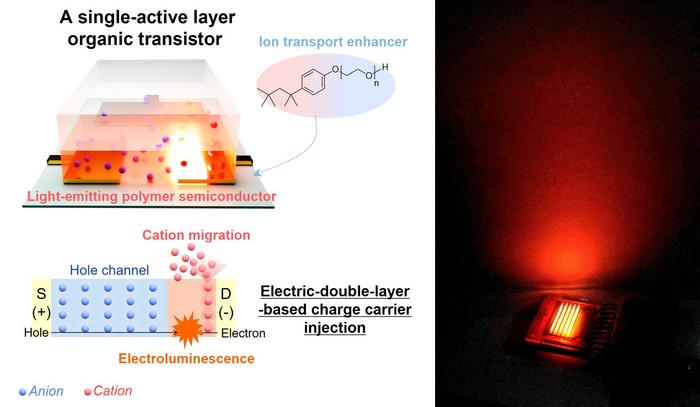
Lee’s group went after the electron problem sideways. The trouble in a polymer like MEH-PPV, the orange-red emitter they used, is that holes flow easily but electrons barely get in at all, so the two never meet to produce light. Their fix was to blend a humble ingredient into the plastic, an ion transport enhancer (in this case a common surfactant, the sort of molecule you might find in a detergent), which lets positively charged ions shuffle through the film far more freely. Those ions pile up at one electrode and form what is called an electric double layer, a wafer-thin sheet of charge that effectively props the door open for electrons. No aggressive chemical doping required.
The upshot is light at startlingly low voltage. The device glows even when the drain voltage sits below the polymer’s own bandgap potential, around 2.17 volts, a threshold that on paper ought to be the floor for emission. In practice the whole thing runs happily on two 1.5-volt batteries, the kind rattling around in a kitchen drawer.
There is a subtler payoff buried in the mechanism, and it may matter more than the voltage. In older electrochemical designs the glowing region forms where a moving junction of positive and negative doping happens to meet, and that meeting point drifts, which makes the emission spot small and twitchy and hard to control. Because Lee’s approach skips the doping front entirely and pins the charge layer to the drain electrode, the light-emitting zone stays put. The researchers measured a recombination zone up to 267 micrometres wide, several times broader than the sub-75-micrometre flickers managed before, and crucially it does not slide around when the gate voltage changes. A wide, stable stripe of light is the difference between a lab curiosity and something you could actually build a display from. They went on to make working arrays, a 4-by-4 and then a 10-by-10 grid of a hundred glowing pixels, and bent and twisted the flexible versions without killing them.
None of this means a rollable plastic television is arriving next year. The brightness, while respectable for the genre at up to 826 candela per square metre, is modest next to a commercial screen, the pixel density is low, and the lifetime, though much improved at thousands of seconds of stable operation, is still measured in hours rather than years.
And the resolution, a couple of pixels per inch in the demonstration arrays, is nowhere near what a phone display needs. This is early-stage stuff, proof that a principle works rather than a product you could buy.
A Patch That Feels Pain
Where it gets genuinely interesting is what the team did with the memory. Because ions linger in the film after a stimulus, the transistor remembers, brightening more under repeated or sustained prods and holding that brightness for a while, much as a nerve grows more responsive to insistent pressure. The researchers wired one into a small, battery-powered, flexible system they call a stand-alone neuromorphic display, designed to mimic the way biological pain works. Gentle contact gets filtered out below a threshold; only a genuinely harmful poke crosses it and triggers a visible flash of light. The pitch is for people with pain-insensitivity disorders, who cannot feel when they are being hurt, and the obvious imagined home for such a thing is artificial skin. “This work is particularly meaningful in that it demonstrates that all functions can be integrated within a single semiconductor device, without the need to separately fabricate and connect processing, memory, and display units,” says Lee.
Whether any of this reaches a clinic or a wrist is, of course, an open question, and the leap from a centimetre-scale patch in a Seoul lab to a certified medical device is a long one. But the underlying idea, that you might not need separate chips for thinking, remembering and showing, has a tidy logic to it that biology arrived at long ago.
For now the group is looking skinward. “Going forward, we plan to further develop this technology into an on-skin semiconductor platform applicable to intelligent artificial skin and wearable healthcare,” says Lee. A glowing scrap of plastic that knows when it has been hurt is a strange object to hold in your head, and stranger still to imagine wearing.
Source: Kim et al., Nature Materials (2026), DOI 10.1038/s41563-026-02613-7
Frequently Asked Questions
How can a transistor and a light source be the same thing?
A transistor controls the flow of electric charge, while a light-emitting diode glows when positive and negative charges meet inside it. If the transistor’s channel is made from a light-emitting plastic, both jobs can happen in the same material: charges flow through it to switch and process signals, and where they recombine, the material glows. The hard part has always been getting electrons into the plastic without enormous voltages, which is what this work solves.
Why does running on two AA batteries matter so much?
Older light-emitting transistors needed anywhere from a few volts to well over a hundred, which rules them out for anything worn on the body. Getting stable, reasonably bright emission below 3.5 volts means the device can run on the same power you would use for a TV remote. That is the threshold at which “wearable” stops being a slogan and starts being plausible.
Is this ready to replace the screen on a phone?
Not remotely. The demonstration arrays hold a hundred pixels at a resolution of roughly two or three pixels per inch, the brightness is modest, and the operating lifetime is measured in hours. It is a proof of principle that the underlying mechanism works, not a finished display you could buy.
What does it mean for the patch to “feel pain”?
The device holds a faint memory of past stimulation because ions linger in its film, so it brightens more under repeated or sustained pressure and ignores gentle contact below a set threshold, much like a biological nerve. The team built a flexible, battery-powered version that flashes only when a poke is strong enough to count as harmful. The imagined use is artificial skin for people who cannot feel pain and so cannot tell when they are being injured.