
In the past 50 years, scientists have made great advances in photovoltaic technologies that convert sunlight into electricity, and artificial photosynthesis devices that convert sunlight and water into carbon-free fuels. But the current state-of-the-art of these clean energy sources still lack the efficiency to compete with electricity or transportation fuel derived from petroleum.
Now, scientists at Berkeley Lab, DESY, the European XFEL, and the Technical University Freiberg, Germany, have reported in Nature Communications their discovery of a hidden charge-generating pathway that could help researchers develop more efficient ways to convert sunlight into electricity or solar fuels like hydrogen.
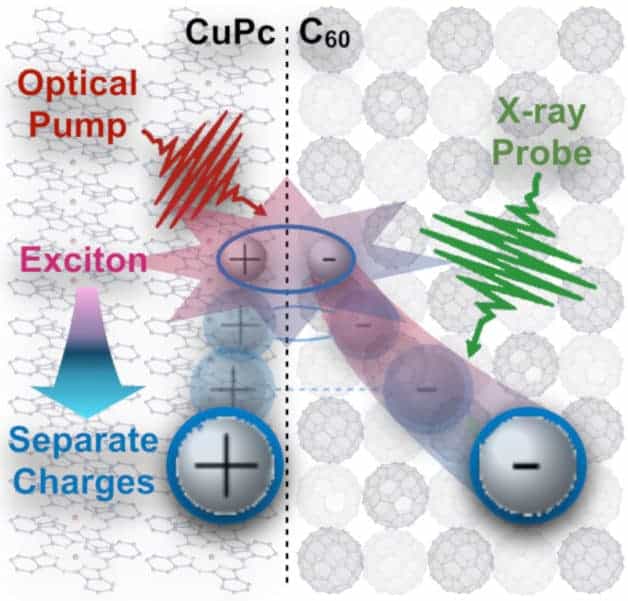
With help from DESY’s free-electron laser FLASH, the researchers shone ultrashort infrared and X-ray laser flashes on a copper-phthalocyanine:fullerene (CuPc:C60) material to study the charge generation mechanisms with a time resolution of 290 femtoseconds (290 quadrillionths of a second).
Combining the ultrashort pulses of light with a technique called time-resolved X-ray photoemission spectroscopy (TRXPS) allowed the researchers to observe and count in real time how many of the infrared photons absorbed by CuPc:C60 formed useful separate charges, and how many of the absorbed photons only led to heating the material.
Their unique approach unveiled an unknown pathway in CuPc:C60 that turns up to 22% of absorbed infrared photons into separate charges, said Oliver Gessner, a senior scientist in Berkeley Lab’s Chemical Sciences Division and co-author of the current study.
Previous studies of CuPc:C60 typically assessed the system’s efficiency by measuring the total amount of charges or hydrogen or oxygen produced when using the material in a photovoltaic or photocatalytic device. “That, however, only tells you how efficient the entire process is, from the light absorption until water is split,” Gessner said. “But there’s a lot that’s happening in between in these systems that isn’t well understood – and if we don’t understand these in-between steps, we can’t develop more efficient light harvesting systems. Our study will help people develop better models and theories so we can get there.”
Additional Information:
“Direct observation of charge separation in an organic light-harvesting system,” DESY news release
ScienceBlog.com has no paywalls, no sponsored content, and no agenda beyond getting the science right. Every story here is written to inform, not to impress an advertiser or push a point of view.
Good science journalism takes time — reading the papers, checking the claims, finding researchers who can put findings in context. We do that work because we think it matters.
If you find this site useful, consider supporting it with a donation. Even a few dollars a month helps keep the coverage independent and free for everyone.