

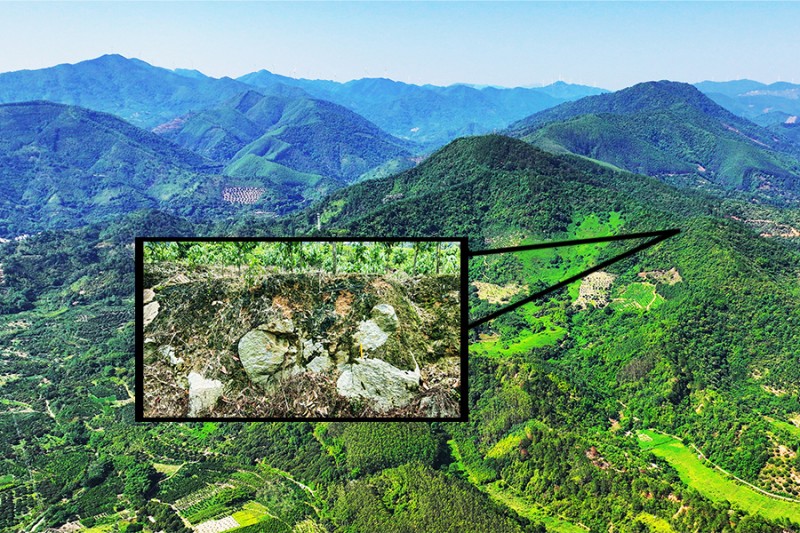
A gentle hillside in southern China hides the vast wound of an ancient collision, reminding us how suddenly the sky can rearrange the Earth. In a new study published in Matter and Radiation at Extremes, researchers from Shanghai and Guangzhou confirm that the Jinlin crater in Guangdong Province is the largest known impact structure from the Holocene, measuring nearly 900 meters across and likely formed within the last 11,700 years.
The team identified shock-altered quartz, mapped the crater’s tilted bowl shape, and reconstructed the impact of a meteorite roughly 30 meters wide. Their findings suggest that the scale of small object impacts during our current epoch has been significantly underestimated.
Tracing a hidden crater in a weathered mountain
The Jinlin crater sits just outside Jinlin Waterside Village in Deqing County, carved into a mountain mantled by an unusually thick granite weathering crust. Despite monsoons, intense rainfall, humidity, and chemical erosion, its rim and bowl remain remarkably intact. The depression spans 900 meters from northeast to southwest, drops about 90 meters from rim to floor, and tilts gently on the slope of the mountain. Large granite fragments, some up to four meters across, lie scattered across the crater floor, while the inner northern rim preserves a dense accumulation of excavated rock.
“This discovery shows that the scale of impacts of small extraterrestrial objects on the Earth in the Holocene is far greater than previously recorded,”
Quartz grains tell the story
The defining evidence lies in the quartz. The research team collected rock fragments from the crater floor and, under microscopic examination, identified planar deformation features, the microscopic lamellae that only form under the extreme shock pressures of an impact. These PDFs appeared in more than fifty quartz grains, arranged in one to three intersecting sets, each roughly one micrometer thick. Their orientations matched known signatures of hypervelocity impacts.
“On the Earth, the formation of planar deformation features in quartz is only from the intense shockwaves generated by celestial body impacts, and its formation pressure ranges from 10 to 35 gigapascals, which is a shock effect that cannot be produced by any geological process of the Earth itself,”
The composition and distribution of debris also illuminate the crater’s formation. The impactor struck through a granite weathering crust that can reach 80 meters thick in this region, a porous layer that acted like a momentum trap. The uphill side, where the crust was thinner, shows more fresh granite fragments, suggesting that the meteorite punched deeper into bedrock before ejecting material toward the rim. The downhill side, cushioned by thicker weathered soil, contains fewer fragments and more loose sediment.
These structural clues, combined with erosion rates of granite in the region, point to an early or mid Holocene age. Granite fragments smaller than 30 centimeters would have fully transformed into residual soil within several thousand years, yet many remain only partially altered. That preservation window narrows the crater’s formation to a recent geological heartbeat.
With only about 200 confirmed impact craters worldwide and only four previously identified in China, the Jinlin crater adds an important data point in a region where warm, wet climates typically erase such scars. Its discovery, scientists note, provides a rare and intact record of how small celestial bodies continue to shape our planet.