

A tiny stent that unfurls inside the body using nothing more than warmth and moisture could reshape the future of minimally invasive vascular care.
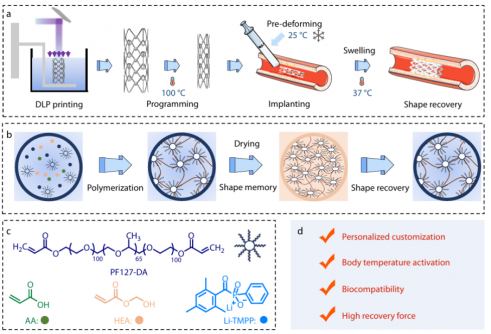
A new study in the Chinese Journal of Polymer Science from Northwestern Polytechnical University introduces a dual stimuli shape memory polymer that expands at body temperature and in physiological fluid. Using DLP based 4D printing, the team created customizable vascular implants that recover their programmed shape with surprising force while remaining soft enough to match vessel tissue. The work, published in 2025, shows that this micelle enhanced material can achieve reliable self expansion under gentle, clinically safe conditions.
The heart of the innovation lies in a nanoscale architecture. Amphiphilic PF127 DA molecules self assemble into micelles inside the printing ink and then lock into a crosslinked network during polymerization. Once dried, the printed structure becomes a strong yet pliable implant that can be compressed for delivery and then triggered to expand when exposed to 37 C and fluid.
Expansion Happens Naturally At Body Temperature
What makes this polymer stand out is its ability to blend softness with strength. Swelling and thermal transition work together, allowing a stent compressed to half its size to push outward with recovery stresses approaching 150 kPa. In a benchtop vascular occlusion model, an 8 millimeter device reopened to 16 millimeters without external heat, light, or mechanical force. This combination of gentle activation and robust expansion addresses one of the key tradeoffs that has challenged previous polymer based vascular implants.
“The micelle-enhanced network allows the polymer to react naturally to the physiological environment,” said the corresponding author.
The material also proved biologically friendly. Fibroblast assays showed low cytotoxicity and good adhesion, an important factor for implants that must remain inside the body under constant motion and stress. Because the device is fabricated through 4D printing, its geometry can be redesigned for each patient, offering a path toward personalized vascular therapeutics rather than one size fits all hardware.
A Platform For Future Soft Implants
The authors highlight that this design concept does not end with stents. Any application requiring shape change inside the body, from tissue scaffolds to drug releasing devices, could benefit from a polymer that activates itself without harsh triggers. The printed network’s ability to store mechanical energy and then release it precisely under physiological conditions may be especially useful for implants that need to expand, bend, or anchor in situ.
“By enabling strong yet gentle expansion at body temperature, the material provides both deployment convenience and compatibility with soft vascular tissues,” the team noted in the study.
Future work will explore biodegradable variants and in vivo performance, but the concept is already compelling. A stent that arrives small, awakens under the warmth of the human body, and gently presses a vessel open could simplify procedures and expand access to customized vascular care.
Chinese Journal of Polymer Science: 10.1007/s10118-025-3423-6