

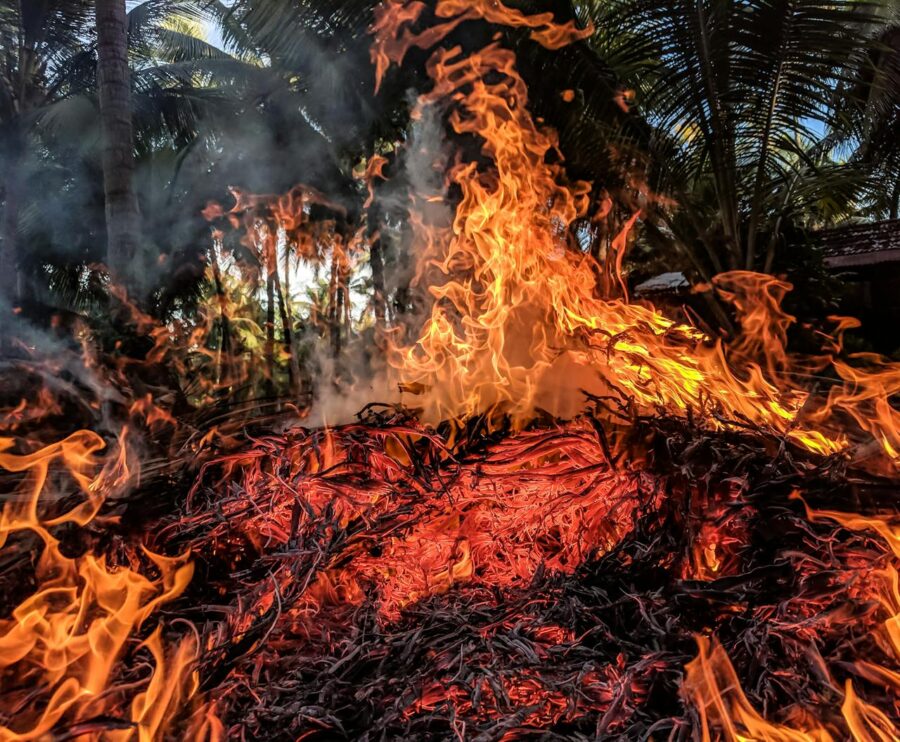
The acrid smell of wildfire smoke is unmistakable. It stings the eyes, coats the lungs, and lingers for days after flames move on. But the visible haze drifting from burning forests and grasslands tells only part of the story. Hidden within that smoke is a sprawling chemical arsenal that scientists have systematically undercounted for decades.
New research tracking global fire data from 1997 to 2023 reveals that wildfires and prescribed burns pump roughly 21 percent more organic pollution into the atmosphere than previous estimates suggested. The culprits are intermediate- and semi-volatile organic compounds, substances that sit between obvious smoke particles and familiar volatile gases. These compounds readily transform into fine particulate matter once airborne, the kind that penetrates deep into lungs and contributes to respiratory and cardiovascular harm.
Traditional emission inventories focused on primary organic aerosols and highly volatile compounds, largely ignoring IVOCs and SVOCs because they’re numerous and difficult to measure. The oversight wasn’t trivial. Researchers now estimate that wildland fires release an average of 143 million tons of airborne organic compounds annually, a figure that reshapes how we understand air quality in fire-prone regions.
The study, led by Shuxiao Wang with first author Lyuyin Huang and published in Environmental Science & Technology, compiled burned area data across forests, grasslands, and peatlands worldwide. Where field measurements were unavailable, laboratory experiments filled the gaps. The result is a full-volatility inventory capturing the entire spectrum of organic gases fires produce.
“Our new estimates increase the organic compound emissions from wildland fires by about 21%,” Lyuyin Huang explains. “The inventory provides a foundation for more detailed air-quality modeling, health-risk assessment and climate-related policy analysis.”
Chemistry in Motion
These hidden compounds behave like steam rising from hot coffee. As fire plumes dilute and cool in the atmosphere, many particles that were originally solid or liquid evaporate into gas. Under typical conditions, roughly 46 to 80 percent of semi-volatile compounds can evaporate, creating a complex chemical mixture that changes composition as it drifts across borders and oceans.
The implications are stark when comparing fire emissions to human activity. People still produce more total organic pollution through transportation and industry, but for IVOCs and SVOCs specifically, fires and human sources contribute similar amounts globally. In fire season peak, the air quality impact of a remote wildfire can rival that of a major industrial city. Fire emissions now sit at about 79 percent of human-caused emissions overall, a gap that’s narrowing.
The increase in estimates comes almost entirely from IVOCs and SVOCs, which are especially efficient at forming fine particulate matter once smoke ages. These particles measure small enough to bypass the body’s defenses, settling in lung tissue and entering the bloodstream.
Peat Smoke Versus Grass Fire
Regional patterns tell different stories. Southern Hemisphere Africa emerged as the top source of fire pollution, with emission rates 1.3 to 6.9 times higher than other major regions like Equatorial Asia or Northern Hemisphere Africa. The 26-year dataset revealed a slight downward trend in certain emissions, driven largely by decreasing grassland fires, which typically release high levels of intermediate gases.
Equatorial Asia presents a distinct challenge. Peatland fires in that region produce smoke with a much higher proportion of semi-volatile compounds compared to grass or forest fires. The acrid smell of burning peat in Indonesia represents a different chemical threat than a fast-moving savannah fire in Africa. These regional differences mean air quality policy can’t rely on universal approaches.
Several hotspots emerged where wildfire emissions overlap with heavy human pollution, including Equatorial Asia, Northern Hemisphere Africa, and Southeast Asia. In these places, reducing air pollution requires managing the combined effects of land burning and everyday human activity, not addressing a single source. Smoke from fires isn’t just episodic disruption but an ongoing contributor to global air quality, one that’s been undercounted in the very inventories designed to protect public health.