
A research team in Shenzhen has found a surprising new energy source hiding in our city sewage.
By recovering phosphorus from municipal wastewater, the team has developed a cleaner, cheaper, and more sustainable way to manufacture lithium iron phosphate (LiFePO4) batteries, crucial components in electric vehicles and grid-scale energy storage systems. The new method transforms chemical sludge into high-performance battery cathodes, offering a two-in-one solution to the growing problems of phosphorus scarcity and urban waste management.
Why Phosphorus Matters in Clean Energy
Phosphorus is a critical element for agriculture, but it is also essential for powering the green energy transition. Lithium iron phosphate batteries, commonly used in electric vehicles and energy storage systems, depend on phosphorus-based compounds for their cathodes. China alone consumed about 240,000 tons of phosphorus for battery production in 2022, putting strain on global supplies.
With most phosphorus derived from mined rock, a finite and increasingly expensive resource, scientists have been searching for alternative sources. Municipal wastewater, rich in phosphorus from human and industrial waste, may be the answer.
Sludge to Cathodes: A Cleaner Process
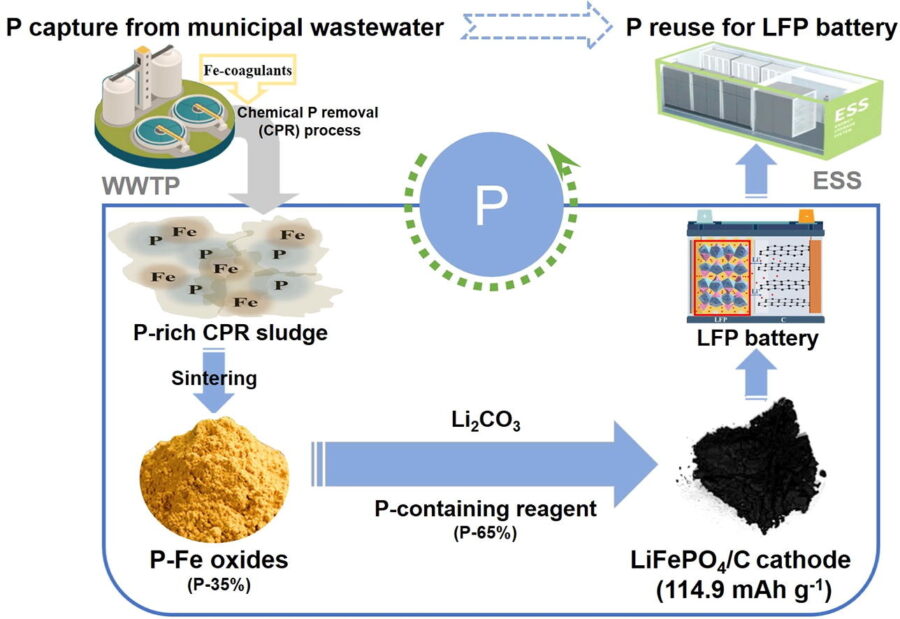
The new recovery method developed at the Shenzhen Engineering Research Laboratory uses a byproduct of chemical phosphorus removal (CPR) in wastewater treatment plants. Iron-based coagulants remove phosphorus from treated water, forming a sludge that typically goes to waste.
Here’s how the team turned that waste into wealth:
- The CPR sludge is rich in phosphorus (about 10% by weight) and iron.
- Researchers sinter the sludge at 600 °C and wash it with mild acid.
- This produces purified iron-phosphate oxides (Fe2.1P1.0O5.6).
- The oxides are used to replace up to 35% of commercial FePO4 in LiFePO4 cathodes.
The resulting LiFePO4/C batteries show strong performance, with specific discharge capacities up to 149.9 mA·h·g−1 and cycle stabilities above 99% after 100 cycles.
More Than Just Batteries: A Sustainable Shift
This recovery method could supply up to 35% of China’s phosphorus needs for lithium batteries, according to the study. That’s not just good news for EV makers. It’s a major win for cities grappling with waste and for global efforts to reduce carbon emissions.
“Unlike conventional phosphorus recovery technologies that produce low-value fertilizers, our method transforms 100% of CPR sludge phosphorus into high-value battery materials,” the authors wrote.
Even the impurities — calcium, sodium, magnesium — seem to help. Small amounts of these elements improve the cathode’s crystal stability and electrochemical performance. The key is not to overdo it. Higher doses of sludge increase resistance and reduce initial battery capacity, but a 25 to 35 percent blend hits the sweet spot for performance and sustainability.
Turning a Waste Stream Into a Supply Chain
The researchers modeled the impact of scaling this process across China. If all municipal wastewater were treated using CPR and sludge-to-cathode conversion, it could yield 94,000 tons of phosphorus annually. That’s enough to cover 39% of the nation’s demand for LiFePO4 battery production in a single year.
Environmental benefits extend beyond raw materials. Each ton of phosphorus recovered through this method could reduce mining-related CO2 emissions by up to 17.2 tons. And with phosphorus prices soaring, this approach also makes economic sense. Net income per ton of sludge processed could rise to over $800, compared to a net loss under fertilizer-based recovery systems.
A Blueprint for Circular Clean Energy
This study flips the script on how we think about waste. Sewage sludge, once a disposal headache, is reimagined as a strategic input for clean energy. By cutting mining, reducing carbon, and lowering battery costs, the process could help power a more resilient, circular economy.
More than a technical fix, it’s a systems-level rethinking, linking urban infrastructure, renewable energy, and global supply chains in a new loop of sustainability.
Published in the journal Engineering. DOI: 10.1016/j.eng.2024.05.018
Discover more from SciChi
Subscribe to get the latest posts sent to your email.