
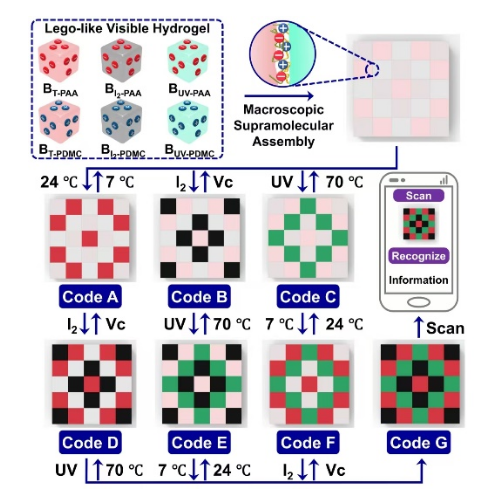
Imagine a QR code that can be rewritten, reshaped, or erased without a computer—just by changing its temperature, shining light, or dipping it in a solution.
Researchers at Beijing University of Chemical Technology have made that possible by creating reconfigurable 3D codes from jelly-like hydrogel cubes. Their study, published in Supramolecular Materials (DOI: 10.1016/j.supmat.2025.100099), shows how these soft building blocks can be assembled like LEGO pieces to store more than 800 billion distinct pieces of information in a compact, physical format.
Turning Soft Materials into Data Carriers
Led by Professors Feng Shi and Mengjiao Cheng, the team designed three types of millimeter-sized hydrogel cubes, each able to change color when exposed to a specific trigger: cold temperatures, UV light, or redox reactions with iodine and vitamin C. Each cube is coated with charged molecules so that opposite charges attract and lock together. This reversible supramolecular chemistry means the cubes can be connected, taken apart, and rearranged at will.
“Unlike fixed QR codes or barcodes, this system can store, erase, rewrite, and reshape information in three dimensions,” said Shi.
How the System Works
Each cube acts as a “pixel” in a 3D code. When arranged into a 5×5 grid, the array can be programmed by stimulus—changing the color of specific cubes—or by physically swapping their positions. The system supports:
- Temperature-responsive red cubes that turn pink below 15°C
- Redox-responsive black cubes that switch between black and white with iodine and vitamin C
- UV-responsive green cubes that revert to white when heated
The combination of physical arrangement and stimulus-controlled color changes allows an enormous number of unique configurations. According to the team’s calculations, a 5×5 grid of these cubes can encode more than 8×10¹¹ different messages. Larger grids could reach “virtually limitless” storage capacity. Reconfigurable hydrogel designs like this draw from advances in adaptive materials science that enable versatile, dynamic information display and storage.
From Secure Tags to Environmental Sensors
Because the codes are made from soft, inexpensive materials and require no electronics, the researchers see potential uses in biomedical tags, environmental sensors, and smart labels for secure data encoding. The cubes can also be reused repeatedly, reducing waste and lowering costs.
“By programming how each surface responds to its environment, we create a system where both the flow and transformation of information become controllable,” said Cheng.
Why It Matters
Traditional 3D-printed codes are static. This approach makes them dynamic and updatable without any digital circuitry. It’s a step toward physical information systems where the material itself—not just an embedded chip—is the information. The team envisions applications where a physical object could carry a code that changes over time, revealing different information depending on environmental conditions or user actions.
Journal Reference
Title: Lego-like Visible Assembly of Responsive Components via Flexible Supramolecular Connectivity to Realize High-capacity Information Encoding
Journal: Supramolecular Materials
DOI: 10.1016/j.supmat.2025.100099
Discover more from SciChi
Subscribe to get the latest posts sent to your email.