
A Catalyst That Heats Itself Up Can Turn Sunlight and CO2 into Fuel
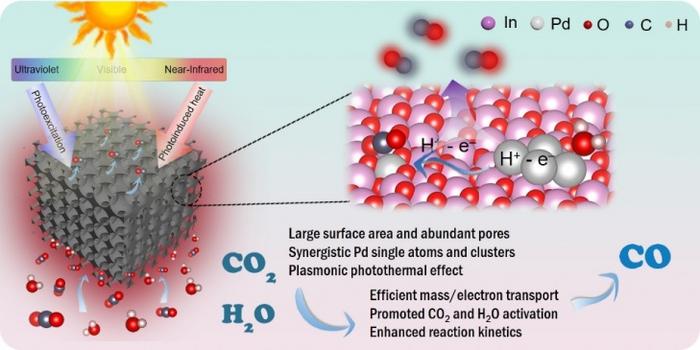
Both Pd single atoms (Pd1) and clusters (Pdc) were constructed in three-dimensional ordered macroporous (3DOM) In2O3 for photocatalytic CO2 reduction with H2O. The large surface area and abundant pore channels of 3DOM-In2O3 facilitate mass transfer and intermediate enrichment. The synergisticPd1 and Pdc active sites enhance the adsorption and activation of CO2 and H2O. The localized surface plasmon resonance of Pd clusters induces a photothermal effect, further accelerating the reaction kinetics.

Light hits a particle of indium oxide, and something unusual happens. The palladium clusters dotting its surface don’t just absorb the photons. They convert them into heat, raising the catalyst’s skin temperature to around 230 degrees Celsius within seconds, even though the source of illumination is nothing more exotic than simulated sunlight. That warmth is … Read more

Yak Gene Could Repair Damaged Nerves in Multiple Sclerosis

Yak

Every nerve fibre in your brain and spinal cord is wrapped in something a bit like electrical tape. The myelin sheath, as it’s called, is a fatty insulating layer produced by specialist cells called oligodendrocytes, and without it, nerve signals lose their speed and coherence. In multiple sclerosis, the immune system attacks this layer directly. … Read more