Skip to content
ScienceBlog.com
  • Featured Blogs
    • EU Horizon Blog
    • ESA Tracker
    • Experimental Frontiers
    • Josh Mitteldorf’s Aging Matters
    • Dr. Lu Zhang’s Gondwanaland
    • NeuroEdge
    • NIAAA
    • SciChi
    • The Poetry of Science
    • Wild Science
  • Topics
    • Brain & Behavior
    • Earth, Energy & Environment
    • Health
    • Life & Non-humans
    • Physics & Mathematics
    • Social Sciences
    • Space
    • Technology
  • Our Substack
  • Follow Us!
    • Bluesky
    • Threads
    • FaceBook
    • Google News
    • Twitter/X
  • Contribute/Contact

3D Technology

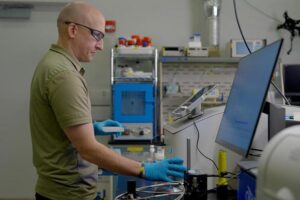
NIST researcher Thomas P. Forbes is working to ensure 3D drug printers work as designed.

Your future medications could be personalized for you on a 3D printer

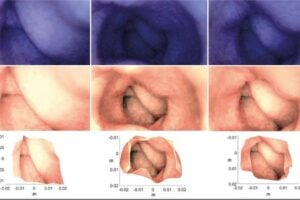
Three original images from an artificial colon, taken using an endoscope. The 3D model can be used to adjust the lighting in an original image so that darker areas become better illuminated, as shown in the images below. Bottom: The reconstructed 3D model based on the three originals.

New 3D Colon Models Could Replace Painful Colonoscopies

A new compact and lightweight single-photon airborne lidar system could make single-photon lidar practical for air and space applications such as 3D terrain mapping.

Lidar System Could Transform Aerial 3D Imaging and Save Lives

Electrospinning is a technique which electrifies droplets of liquid to form fibres from plastics. Previously, scientists had only been able to make 2D films. This is the first time anybody has electro-spun a 3D structure directly and on-demand so that it can be produced to scale.

Lab-spun sponges form perfect scaffolds for growing skin cells to heal wounds

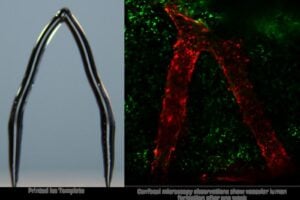
3D ice printing can create artificial blood vessels in engineered tissue

3D ice printing can create artificial blood vessels in engineered tissue

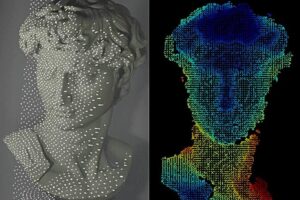
A new lens-free and compact system for facial recognition scans a bust of Michelangelo’s David and reconstructs the image using less power than existing 3D surface imaging systems.

A sleeker facial recognition technology tested on Michelangelo’s David

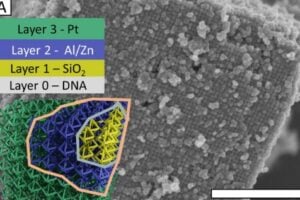
3D metallic and semiconductor nanostructure

Hacking DNA to Make Next-Gen Materials

Warda Ashraf

A bold plan to 3D print artificial coral reef

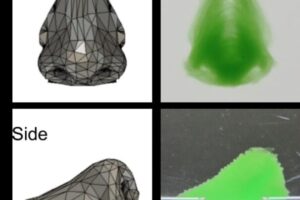
Human nose structure 3D printed with a support material.

Cell-friendly bioprinting at high fidelity enhances its medical applicability

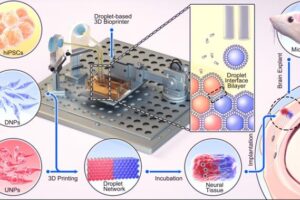
Droplets containing human iPSC-derived neural progenitors were 3D-printed to form 2-layer cerebral cortical tissue, which was cultured before implantation into a mouse brain slice. DNPs: deep-layer neural progenitors; UNPs: upper-layer neural progenitors. Image credit: Yongcheng Jin, University of Oxford.

3D printing method shows promise for repairing brain injuries

Caption:MIT researchers developed a user-friendly interface that enables a maker to customize the color, texture, and shape of the aesthetic characteristics of an open-source 3D model from an online repository, without affecting the functionality of the fabricated object. Credits:Image: Courtesy of the researchers

AI-driven tool makes it easy to personalize 3D-printable models

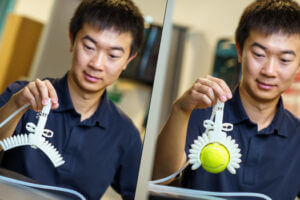
Example of new UC San Diego device that can grip objects with no electronics involved.

This 3D Printed Gripper Doesn’t Need Electronics To Function

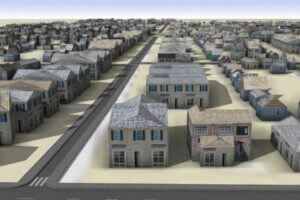
Illustration of old neighborhood in 3d

Turning old maps into 3D digital models of lost neighborhoods

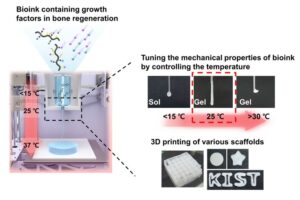
Tuning mechanical properties of bioink according to temperature and 3d scaffold printing

Safe bioink for artificial organ printing

Older posts
Newer posts
← Previous Page1 Page2 Page3 Next →
Substack subscription form sign up

Comments

  • Karoly Mirnics on Common Prescription Drugs May Disrupt Cholesterol Pathways in the Womb and Raise Autism Risk
  • Aizen on Laziness helped lead to extinction of Homo erectus
  • Norwood johnson on Electrons in New Crystals Behave as If They Live in Four Dimensions
  • ScienceBlog.com on Hidden Geometry Could Finally Fix Quantum Computers
  • Theo Prinse on America Is Going Back to the Moon. This Time, It Plans to Stay
© 2026 ScienceBlog.com | Follow our RSS / XML feed