Skip to content
ScienceBlog.com
  • Featured Blogs
    • EU Horizon Blog
    • ESA Tracker
    • Experimental Frontiers
    • Josh Mitteldorf’s Aging Matters
    • Dr. Lu Zhang’s Gondwanaland
    • NeuroEdge
    • NIAAA
    • SciChi
    • The Poetry of Science
    • Wild Science
  • Topics
    • Brain & Behavior
    • Earth, Energy & Environment
    • Health
    • Life & Non-humans
    • Physics & Mathematics
    • Social Sciences
    • Space
    • Technology
  • Our Substack
  • Follow Us!
    • Bluesky
    • Threads
    • FaceBook
    • Google News
    • Twitter/X
  • Contribute/Contact

Allergies

woman with an itchy arm

Why Some People Itch More from Allergens and Mosquito Bites

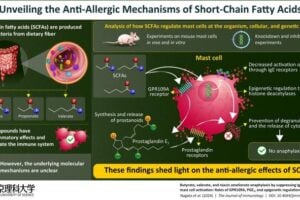
Gut bacteria break down dietary fiber into short-chain fatty acids, which are known to affect our immune system. In this study, researchers investigated in detail the mechanisms by which these compounds mediate the activation of mast cells.

Gut bacteria can process dietary fiber into an anti-allergy weapon

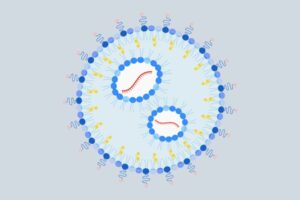
The UCLA-developed nanoparticle has sugars on its surface that target specific cells in the liver (dark blue and pink shapes) and an mRNA payload that encodes for a specific protein fragment (red).

Nanoparticle with mRNA appears to prevent, treat peanut allergies in mice

Substack subscription form sign up

Comments

  • Marco Messina on More Than a Third of Americans Have Lost Relationships Over Politics
  • Anon on Why Fructose Behaves Less Like a Calorie and More Like a Hormone
  • Mark Mellinger on Living Plastic Can Self-Destruct on Command
  • Marie Feret on The Silent Frequency That Makes Old Buildings Feel Haunted
  • Dax on The Silent Frequency That Makes Old Buildings Feel Haunted
© 2026 ScienceBlog.com | Follow our RSS / XML feed