Skip to content
ScienceBlog.com
  • Featured Blogs
    • EU Horizon Blog
    • ESA Tracker
    • Experimental Frontiers
    • Josh Mitteldorf’s Aging Matters
    • Dr. Lu Zhang’s Gondwanaland
    • NeuroEdge
    • NIAAA
    • SciChi
    • The Poetry of Science
    • Wild Science
  • Topics
    • Brain & Behavior
    • Earth, Energy & Environment
    • Health
    • Life & Non-humans
    • Physics & Mathematics
    • Social Sciences
    • Space
    • Technology
  • Our Substack
  • Follow Us!
    • Bluesky
    • Threads
    • FaceBook
    • Google News
    • Twitter/X
  • Contribute/Contact

Ancient parasites

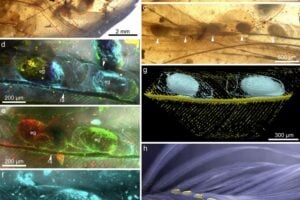
Figure 1. Fossilized nits of chewing lice, tightly affixed to feathers of an enantiornithine bird, entombed in mid-Cretaceous amber from northern Myanmar. (a) Isolated barbs and regularly arranged louse nits attached to two barbs of the same type. (b) Enlargement of six louse nits (indicated with black arrows). (c) Enlargement of five louse nits (indicated with white arrows). (d) and (e), Enlargement of louse nits. (f) Details of a nit, showing the placement, attachment, and details of the chorion. (g) Enlargement of two louse nits, showing the attachments to ramus. (h) Ecological reconstruction of Cretaceous chewing lice of an enantiornithine bird. (a–c) Under normal reflected light. (d–f) Under confocal laser scanning microscopy. (g) Under X-ray micro-computed tomography. Abbreviations: ch, chorion; eg, egg; ra, ramus.

Ancient Amber Reveals 99-Million-Year-Old Evidence of Bird Parasites

Substack subscription form sign up

Comments

  • Marco Messina on More Than a Third of Americans Have Lost Relationships Over Politics
  • Anon on Why Fructose Behaves Less Like a Calorie and More Like a Hormone
  • Mark Mellinger on Living Plastic Can Self-Destruct on Command
  • Marie Feret on The Silent Frequency That Makes Old Buildings Feel Haunted
  • Dax on The Silent Frequency That Makes Old Buildings Feel Haunted
© 2026 ScienceBlog.com | Follow our RSS / XML feed