Skip to content
ScienceBlog.com
  • Featured Blogs
    • EU Horizon Blog
    • ESA Tracker
    • Experimental Frontiers
    • Josh Mitteldorf’s Aging Matters
    • Dr. Lu Zhang’s Gondwanaland
    • NeuroEdge
    • NIAAA
    • SciChi
    • The Poetry of Science
    • Wild Science
  • Topics
    • Brain & Behavior
    • Earth, Energy & Environment
    • Health
    • Life & Non-humans
    • Physics & Mathematics
    • Social Sciences
    • Space
    • Technology
  • Our Substack
  • Follow Us!
    • Bluesky
    • Threads
    • FaceBook
    • Google News
    • Twitter/X
  • Contribute/Contact

Antimatter

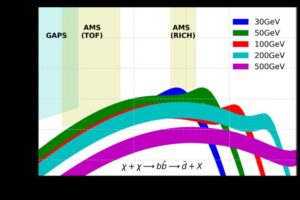
The image shows the predicted flux of antihelium-3 produced from dark matter (WIMPs) that annihilate producing these antinuclei. Each color represents the prediction for a different mass of dark matter, as shown in the legend. t The bands are almost touching the AMS-02 sensitivity, which means that in some optimistic cases, WIMPs can explain this discrepancy.

Glimmers of antimatter to explain the “dark” part of the universe

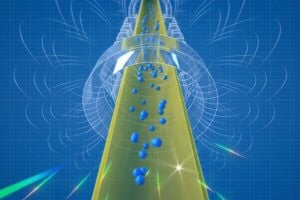
An artist's conceptual rendering of antihydrogen atoms falling out the bottom of the magnetic trap of the ALPHA-g apparatus. As the antihydrogen atoms escape, they touch the chamber walls and annihilate. Most of the annihilations occur beneath the chamber, showing that gravity is pulling the antihydrogen down. The rotating magnetic field lines in the animation represent the invisible influence of the magnetic field on the antihydrogen. The magnetic field does not rotate in the actual experiment.

Down goes antimatter! Gravity’s effect on matter’s elusive twin is revealed

Substack subscription form sign up

Comments

  • Norwood johnson on Electrons in New Crystals Behave as If They Live in Four Dimensions
  • ScienceBlog.com on Hidden Geometry Could Finally Fix Quantum Computers
  • Theo Prinse on America Is Going Back to the Moon. This Time, It Plans to Stay
  • george w on Hidden Geometry Could Finally Fix Quantum Computers
  • Tom Hughes on Years of Exercise, Blood Pressure Drugs Failed to Slow Cognitive Decline in Seniors at Dementia Risk
© 2026 ScienceBlog.com | Follow our RSS / XML feed