Skip to content
ScienceBlog.com
  • Featured Blogs
    • EU Horizon Blog
    • ESA Tracker
    • Experimental Frontiers
    • Josh Mitteldorf’s Aging Matters
    • Dr. Lu Zhang’s Gondwanaland
    • NeuroEdge
    • NIAAA
    • SciChi
    • The Poetry of Science
    • Wild Science
  • Topics
    • Brain & Behavior
    • Earth, Energy & Environment
    • Health
    • Life & Non-humans
    • Physics & Mathematics
    • Social Sciences
    • Space
    • Technology
  • Our Substack
  • Follow Us!
    • Bluesky
    • Threads
    • FaceBook
    • Google News
    • Twitter/X
  • Contribute/Contact

Asteroids

Colorized microscopic image of sodium carbonate deposit on Ryugu sample

Ancient Space Salt Reveals Solar System’s Watery Past

The geological features observed on Didymos provided key insights into its origins. The asteroid's triangular ridge (shown in the first panel from the left), along with the smooth region and the older, rougher "highland" region (depicted in the second panel from the left), can be explained by slope processes influenced by elevation (illustrated in the third panel from the left). The fourth panel demonstrates the impact of spin-up disruption, which likely played a role in the formation of Dimorphos.

DART Mission Reveals Ancient Origins and Fragile Structures of Asteroids

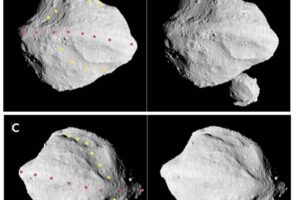
Panels a, b, and c each show stereographic image pairs of the asteroid Dinkinesh taken by the NASA Lucy Spacecraft’s L’LORRI Instrument in the minutes around closest approach on Nov. 1, 2023. The yellow and rose dots indicate the trough and ridge features, respectively. These images have been sharpened and processed to enhance contrast. Panel d shows a side view of Dinkinesh and its satellite Selam taken a few minutes after closest approach. Credit: NASA/SwRI/Johns Hopkins APL/NOIRLab.

Lucy Spacecraft Discovers Unexpected Contact Binary Orbiting Asteroid Dinkinesh

Dinkinesh

NASA’s Lucy Mission Unearths Celestial Surprise: Binary Asteroid Dance

Image of the asteroid Dimorphos, with compass arrows, scale bar, and color key for reference. The north and east compass arrows show the orientation of the image on the sky. Note that the relationship between north and east on the sky (as seen from below) is flipped relative to direction arrows on a map of the ground (as seen from above).

Hubble sees boulders escaping from asteroid dimorphos

Asteroid Itokawa

Nukes needed to save Earth from common killer asteroid

Substack subscription form sign up

Comments

  • Karoly Mirnics on Common Prescription Drugs May Disrupt Cholesterol Pathways in the Womb and Raise Autism Risk
  • Aizen on Laziness helped lead to extinction of Homo erectus
  • Norwood johnson on Electrons in New Crystals Behave as If They Live in Four Dimensions
  • ScienceBlog.com on Hidden Geometry Could Finally Fix Quantum Computers
  • Theo Prinse on America Is Going Back to the Moon. This Time, It Plans to Stay
© 2026 ScienceBlog.com | Follow our RSS / XML feed