Skip to content
ScienceBlog.com
  • Featured Blogs
    • EU Horizon Blog
    • ESA Tracker
    • Experimental Frontiers
    • Josh Mitteldorf’s Aging Matters
    • Dr. Lu Zhang’s Gondwanaland
    • NeuroEdge
    • NIAAA
    • SciChi
    • The Poetry of Science
    • Wild Science
  • Topics
    • Brain & Behavior
    • Earth, Energy & Environment
    • Health
    • Life & Non-humans
    • Physics & Mathematics
    • Social Sciences
    • Space
    • Technology
  • Our Substack
  • Follow Us!
    • Bluesky
    • Threads
    • FaceBook
    • Google News
    • Twitter/X
  • Contribute/Contact

Astrophysics

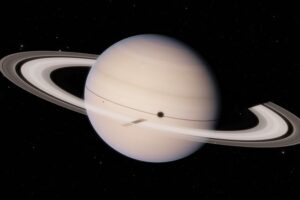
The panet Saturn with its trademark rings

Saturn’s rings are really young and mostly water

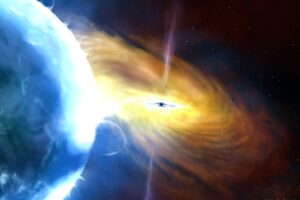
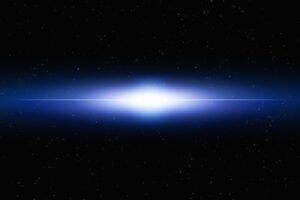
Illustration: a black hole accretion.

Biggest Explosion Ever

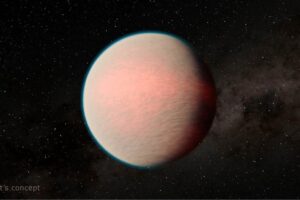
Artist’s concept of the planet GJ 1214 b, a “mini-Neptune” with what is likely a steamy, hazy atmosphere. Credit: NASA/JPL-Caltech/R. Hurt (IPAC)

Planet has surprisingly cool attitude: ‘I’m not hot, I’m just reflective’

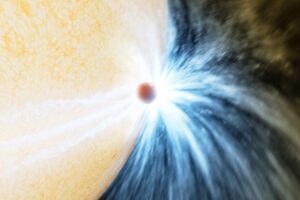
ZTF and NEOWISE spot evidence for the first known case of a star engulfing its planet

Star Eats Planet, Brightens Dramatically

Illustration: Bibiana Prinoth

Scientists discover rare element terbium in exoplanet’s atmosphere

An artist's rendering of quasar P172+18

Mystery of quasars solved: Most powerful objects in the Universe ignited by colliding galaxies

New image of M87 supermassive black hole generated by the PRIMO algorithm using 2017 EHT data

A sharper look at the M87 black hole

galaxy clusters

Galaxy clusters yield new evidence for standard model of cosmology

sun

Shedding light on the Sun

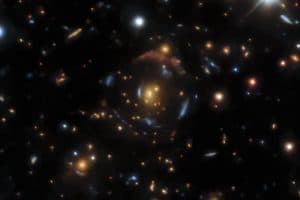
An example of a gravitational lens found in the DESI Legacy Surveys data. There are four sets of lensed images in DESI-090.9854-35.9683, corresponding to four distinct background galaxies — from the outermost giant red arc to the innermost bright blue arc, arranged in four concentric circles. All of them are gravitationally warped — or lensed — by the orange galaxy at the very center.

Astrophysicists show how to “weigh” galaxy clusters with artificial intelligence

Many chemical elements are formed during a supernova explosion, so studying them can give scientists insight into the universe's chemical make-up.

Galactic explosion offers astrophysicists new insight into the cosmos

Artist’s Impression of the “Tadpole” Molecular Cloud and the black hole at the gravitational center of its orbit.

‘Tadpole’ Spotted Playing Around Black Hole

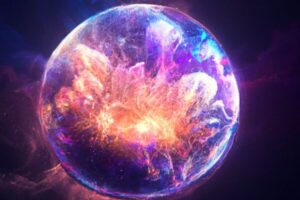
Illustration of spherical explosion

Astrophysicists discover the perfect explosion in space

The mysterious black behemoths controlling our galaxies

Older posts
Newer posts
← Previous Page1 … Page5 Page6 Page7 Next →
Substack subscription form sign up

Comments

  • Karoly Mirnics on Common Prescription Drugs May Disrupt Cholesterol Pathways in the Womb and Raise Autism Risk
  • Aizen on Laziness helped lead to extinction of Homo erectus
  • Norwood johnson on Electrons in New Crystals Behave as If They Live in Four Dimensions
  • ScienceBlog.com on Hidden Geometry Could Finally Fix Quantum Computers
  • Theo Prinse on America Is Going Back to the Moon. This Time, It Plans to Stay
© 2026 ScienceBlog.com | Follow our RSS / XML feed