Skip to content
ScienceBlog.com
  • Featured Blogs
    • EU Horizon Blog
    • ESA Tracker
    • Experimental Frontiers
    • Josh Mitteldorf’s Aging Matters
    • Dr. Lu Zhang’s Gondwanaland
    • NeuroEdge
    • NIAAA
    • SciChi
    • The Poetry of Science
    • Wild Science
  • Topics
    • Brain & Behavior
    • Earth, Energy & Environment
    • Health
    • Life & Non-humans
    • Physics & Mathematics
    • Social Sciences
    • Space
    • Technology
  • Our Substack
  • Follow Us!
    • Bluesky
    • Threads
    • FaceBook
    • Google News
    • Twitter/X
  • Contribute/Contact

Atmosphere

An artist’s rendition of a Neptune-like exoplanet. Photo Credit: NASA, ESA, CSA, R. Crawford (STScI

Today’s forecast: partially cloudy skies on an “ultra-hot Neptune”

city scene during rain

Microplastics in the Sky: How Tiny Plastic Particles May Be Reshaping Our Weather

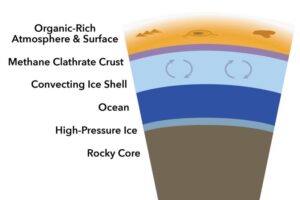
Proposed diagram of Titan's interior (not to scale), showing a methane clathrate crust over a convecting ice shell.

Saturn’s moon Titan has insulating methane-rich crust up to six miles thick

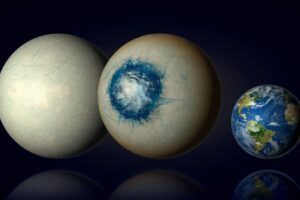
Temperate exoplanet LHS 1140 b may be a world completely covered in ice (left) similar to Jupiter’s moon Europa or be an ice world with a liquid substellar ocean and a cloudy atmosphere (centre). LHS 1140 b is 1.7 times the size of our planet Earth (right) and is the most promising habitable zone exoplanet yet in our search for liquid water beyond the Solar System. Image credit: B. Gougeon/Université de Montréal

Astronomers find surprising ice world in the habitable zone

Ohio State logo

Researchers spying for signs of life among exoplanet atmospheres

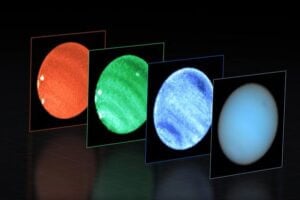
This image shows Neptune observed with the MUSE instrument at ESO’s Very Large Telescope (VLT). At each pixel within Neptune, MUSE splits the incoming light into its constituent colours or wavelengths. This is similar to obtaining images at thousands of different wavelengths all at once, which provides a wealth of valuable information to astronomers. The image to the right combines all colours captured by MUSE into a “natural” view of Neptune, where a dark spot can be seen to the upper-right. Then we see images at specific wavelengths: 551 nanometres (blue), 831 nm (green), and 848 nm (red); note that the colours are only indicative, for display purposes. The dark spot is most prominent at shorter (bluer) wavelengths. Right next to this dark spot MUSE also captured a small bright one, seen here only in the middle image at 831 nm and located deep in the atmosphere. This type of deep bright cloud had never been identified before on the planet. The images also show several other shallower bright spots towards the bottom-left edge of Neptune, seen at long wavelengths. Imaging Neptune’s dark spot from the ground was only possible thanks to the VLT’s Adaptive Optics Facility, which corrects the blur caused by atmospheric turbulence and allows MUSE to obtain crystal clear images. To better highlight the subtle dark and bright features on the planet, the astronomers carefully processed the MUSE data, obtaining what you see here.

Mysterious Neptune dark spot detected from Earth for the first time

Substack subscription form sign up

Comments

  • Brunette Keller on How New Herpes Drugs Jam a Virus’s Replication Engine
  • Aizen on Laziness helped lead to extinction of Homo erectus
  • Norwood johnson on Electrons in New Crystals Behave as If They Live in Four Dimensions
  • ScienceBlog.com on Hidden Geometry Could Finally Fix Quantum Computers
  • Theo Prinse on America Is Going Back to the Moon. This Time, It Plans to Stay
© 2026 ScienceBlog.com | Follow our RSS / XML feed