Skip to content
ScienceBlog.com
  • Featured Blogs
    • EU Horizon Blog
    • ESA Tracker
    • Experimental Frontiers
    • Josh Mitteldorf’s Aging Matters
    • Dr. Lu Zhang’s Gondwanaland
    • NeuroEdge
    • NIAAA
    • SciChi
    • The Poetry of Science
    • Wild Science
  • Topics
    • Brain & Behavior
    • Earth, Energy & Environment
    • Health
    • Life & Non-humans
    • Physics & Mathematics
    • Social Sciences
    • Space
    • Technology
  • Our Substack
  • Follow Us!
    • Bluesky
    • Threads
    • FaceBook
    • Google News
    • Twitter/X
  • Contribute/Contact

Atmospheric Sciences

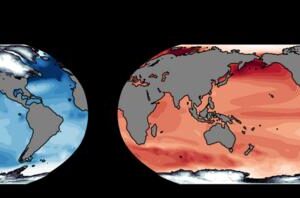
The left panel illustrates sea surface temperature variations between the most recent ice age, approximately 21,000 years ago, and modern preindustrial temperatures. This refined analysis highlights significant cooling over the northern oceans, attributed to the presence of the North American ice sheet, which significantly contributed to the overall global cooling trend. In contrast, the right panel depicts anticipated changes in ocean surface temperatures under a scenario of doubled atmospheric CO2 concentrations in the future. This projection reveals a distinct pattern of temperature change, suggesting lower globally averaged warming than previously anticipated in worst-case scenarios.

New Study Reduces Absolute Worst-Case Warming Scenario

Substack subscription form sign up

Comments

  • Karoly Mirnics on Common Prescription Drugs May Disrupt Cholesterol Pathways in the Womb and Raise Autism Risk
  • Aizen on Laziness helped lead to extinction of Homo erectus
  • Norwood johnson on Electrons in New Crystals Behave as If They Live in Four Dimensions
  • ScienceBlog.com on Hidden Geometry Could Finally Fix Quantum Computers
  • Theo Prinse on America Is Going Back to the Moon. This Time, It Plans to Stay
© 2026 ScienceBlog.com | Follow our RSS / XML feed