Skip to content
ScienceBlog.com
  • Featured Blogs
    • EU Horizon Blog
    • ESA Tracker
    • Experimental Frontiers
    • Josh Mitteldorf’s Aging Matters
    • Dr. Lu Zhang’s Gondwanaland
    • NeuroEdge
    • NIAAA
    • SciChi
    • The Poetry of Science
    • Wild Science
  • Topics
    • Brain & Behavior
    • Earth, Energy & Environment
    • Health
    • Life & Non-humans
    • Physics & Mathematics
    • Social Sciences
    • Space
    • Technology
  • Our Substack
  • Follow Us!
    • Bluesky
    • Threads
    • FaceBook
    • Google News
    • Twitter/X
  • Contribute/Contact

bio

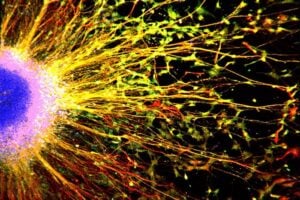
A brain organoid culture, where the MECP2 gene (linked to Rett syndrome) has been knocked out, is shown under a fluorescent microscope. The culture was treated with the experimental cancer drug ADH-503, resulting in the formation of new synapses.

Living Neural Interfaces Could Transform Treatment of Brain Disorders

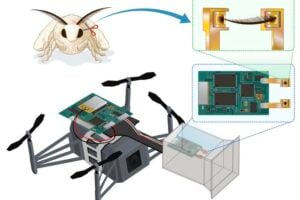
Researchers from Shinshu University and Chiba University develop a novel bio-hybrid drone using odor-sensing antennae from silkworm moths. Incorporation of an electroantennography (EAG) sensor to detect odorants and optimization of the electrode and enclosure structure in the robot enhanced the odor search range, detection precision, and system performance of the drone, thus, improving its application in diverse environments.

Bio-hybrid drone uses silkworm moth antennae to navigate using smell

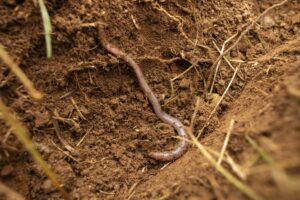
A new study in the journal Environmental Science and Technology tested the effects of conventional polyester fibres and two bio-based fibres –viscose and lyocell – on earthworms, a species critical to the health of soils globally

Study Reveals Unexpected Environmental Risks of ‘Eco-Friendly’ Bio-based Fibers

An artificial hand attached to a body

Development of living, ‘Bio-hybrid’ robots needs regulation and public debate

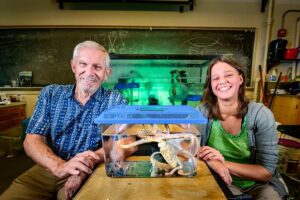
Rhanor Gillette, left, and Ekaterina Gribkova developed an AI that can navigate new environments, seek novelty and rewards, and learn in real time. Their research into the neural pathways that drive behavior in sea slugs and octopuses guided the work.

New AI ‘CyberOctopus’ Learns Like Animals, Navigates and Explores on Its Own

robotic spider

Robots Still Lag Behind Animals in Foot Races

blue ring octopus

Octopus-inspired technology that can deceive and signal

New bio-based glues form bonds that grow stronger in water

Beyond the bin: giving biowaste a second life

Robotic bees and roots offer hope of healthier environment and sufficient food

Photo of bird-like robot

Researchers Develop Robot That Can Land on a Branch Like a Bird

Nanomia bijuga, a marine animal related to jellyfish, swims via jet propulsion.

Gelatinous animals are inspiring underwater vehicle design

Substack subscription form sign up

Comments

  • Karoly Mirnics on Common Prescription Drugs May Disrupt Cholesterol Pathways in the Womb and Raise Autism Risk
  • Aizen on Laziness helped lead to extinction of Homo erectus
  • Norwood johnson on Electrons in New Crystals Behave as If They Live in Four Dimensions
  • ScienceBlog.com on Hidden Geometry Could Finally Fix Quantum Computers
  • Theo Prinse on America Is Going Back to the Moon. This Time, It Plans to Stay
© 2026 ScienceBlog.com | Follow our RSS / XML feed