Skip to content
ScienceBlog.com
  • Featured Blogs
    • EU Horizon Blog
    • ESA Tracker
    • Experimental Frontiers
    • Josh Mitteldorf’s Aging Matters
    • Dr. Lu Zhang’s Gondwanaland
    • NeuroEdge
    • NIAAA
    • SciChi
    • The Poetry of Science
    • Wild Science
  • Topics
    • Brain & Behavior
    • Earth, Energy & Environment
    • Health
    • Life & Non-humans
    • Physics & Mathematics
    • Social Sciences
    • Space
    • Technology
  • Our Substack
  • Follow Us!
    • Bluesky
    • Threads
    • FaceBook
    • Google News
    • Twitter/X
  • Contribute/Contact

Biomedical engineering

Apigenin loaded nanoparticles for obesity

New Dual-Action Nanoparticles Turn Body Fat Into Calorie-Burning Machines

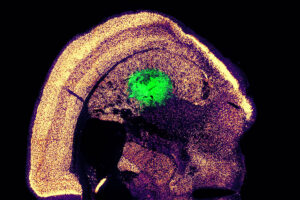
Researchers at MIT have devised a simplified process to convert a skin cell directly into a neuron. This image shows converted neurons (green) that have integrated with neurons in the brain’s striatum after implantation.

Scientists Crack Code to Transform Skin Cells Directly into Neurons

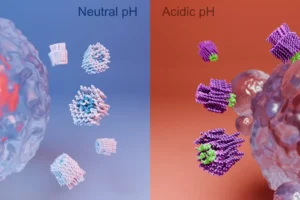
The nanorobot's weapon can only be exposed in the acidic environment found in and around a solid tumour. Illustration: Boxuan Shen

Stealthy Nanorobots Target and Destroy Cancer Cells in Mice

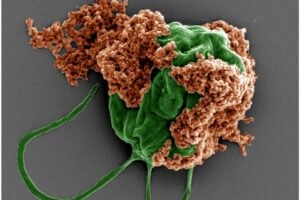
Colored SEM image of a microrobot made of an algae cell (green) covered with drug-filled nanoparticles (orange) coated with red blood cell membranes. Scale bar: 2 µm.

Microrobots Deliver Cancer-Fighting Drugs Directly to Lung Tumors, Boosting Survival in Mice

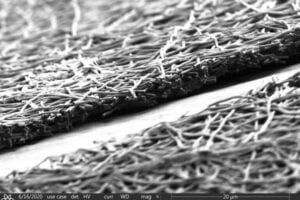
A new ultrathin silk membrane for organ-on-a-chip platforms helps cells communicate and grow into functional tissues used for research

Ultrathin Silk Membrane Revolutionizes Organ-on-a-Chip Technology

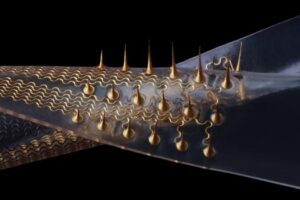
Stretchable microneedle electrode arrays.

Sea Slugs Inspire Flexible Microneedle Electrodes for Seamless Health Monitoring

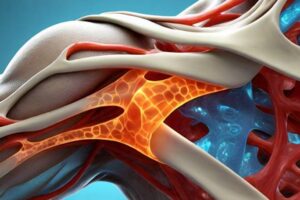
A digital illustration of a human shoulder joint, with the rotator cuff tendons and bursa highlighted in different colors.

Removing Shoulder Bursa During Rotator Cuff Surgery May Impair Healing

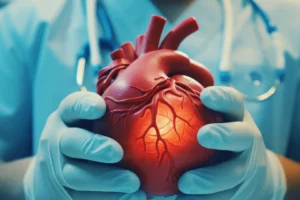
Illustration of surgeon holding a heart

Hydrogels can help mend a broken heart

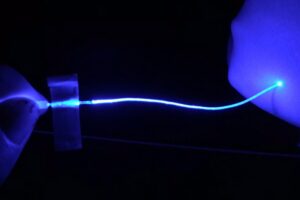
Fiber glowing blue

Soft optical fibers block pain while moving and stretching with the body

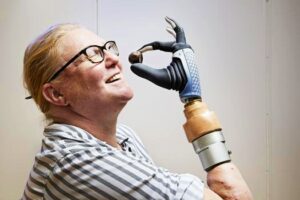
First person with a below-elbow amputation who received a bionic hand directly connected to her neuromusculoskeletal system

Bionic hand merges with user’s nervous and skeletal systems, remaining functional after years of daily use

A figure illustrating how a “closed-loop” implant called HAMMR (short for “hybrid advanced molecular manufacturing regulator”) will be used to treat recurrent ovarian cancer. The implant, which is small enough to be implanted with minimally invasive surgery, is being developed by a Rice University-led team of researchers from eight universities and two companies in seven states. The Advanced Research Projects Agency for Health awarded $45 million to fast-track development of the implant, which includes funding for a first-phase clinical trial within five years.

Feds fund research that could slash US cancer deaths by 50%

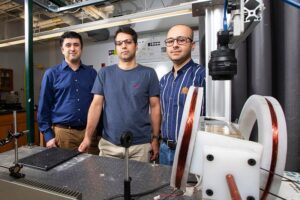
Kourosh Shoele, an assistant professor of Mechanical Engineering, Hadi Mohammadigoushki, Associate Professor of Chemical and Biomedical Engineering and Farshad Nazarinasrabad, a doctoral candidate in chemical engineering at the FAMU-FSU College of Engineering. (Mark Wallheiser/FAMU-FSU College of Engineering)

Bacteria Dance the Twist in Our Stomachs: H. pylori Gets Its Groove On

Tom de Greef CREDIT Bart van Overbeeke / Eindhoven University of Technology (TU/e)

The future of data storage lies in DNA microcapsules

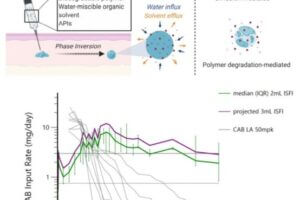
Top: Illustration of formation of solid implant by phase inversion and drug release via diffusion and implant degradation. Bottom: Modeling predicted a 2 mL and 3 mL injection can sustain plasma concentrations of CAB above levels needed for protection against HIV in humans for 4 and 5 months respectively.

Implant offers potential long-term HIV protection

Older posts
Page1 Page2 Next →
Substack subscription form sign up

Comments

  • Karoly Mirnics on Common Prescription Drugs May Disrupt Cholesterol Pathways in the Womb and Raise Autism Risk
  • Aizen on Laziness helped lead to extinction of Homo erectus
  • Norwood johnson on Electrons in New Crystals Behave as If They Live in Four Dimensions
  • ScienceBlog.com on Hidden Geometry Could Finally Fix Quantum Computers
  • Theo Prinse on America Is Going Back to the Moon. This Time, It Plans to Stay
© 2026 ScienceBlog.com | Follow our RSS / XML feed