Skip to content
ScienceBlog.com
  • Featured Blogs
    • EU Horizon Blog
    • ESA Tracker
    • Experimental Frontiers
    • Josh Mitteldorf’s Aging Matters
    • Dr. Lu Zhang’s Gondwanaland
    • NeuroEdge
    • NIAAA
    • SciChi
    • The Poetry of Science
    • Wild Science
  • Topics
    • Brain & Behavior
    • Earth, Energy & Environment
    • Health
    • Life & Non-humans
    • Physics & Mathematics
    • Social Sciences
    • Space
    • Technology
  • Our Substack
  • Follow Us!
    • Bluesky
    • Threads
    • FaceBook
    • Google News
    • Twitter/X
  • Contribute/Contact

biomedical research

geese at a park

Middle School Student’s Park Discovery Leads to Promising Cancer-Fighting Compound

blue light sleeping woman

Females sleep less, wake up more often than males

Researchers at WashU Medicine have developed a method in mice to reduce damage from spinal cord injuries by using engineered immune cells. Mice that received this treatment showed improved recovery from their injuries, indicating potential for developing this therapy for human use.

New Discovery Could Help Fine-Tune Scarring in Spinal Cord Injuries

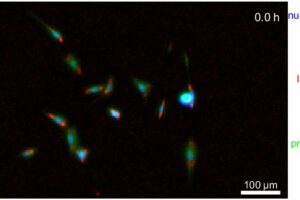
An image of biomolecules, such as nucleic acids, lipids and proteins, in live cells using an imaging technique called infrared (IR) transmission microscopy. Credit: Y. Lee/NIST

New IR Imaging Technique Reveals Biomolecules in Living Cells

digital illustration of a mouse

Stress-free method weighs mice using computer vision

Ohio State logo

Finding a solution for long COVID, one cell type at a time

UCLA Health's Semel Institute for Neuroscience and Human Behavior living lab will be home to psychedelic and Ecological Medicine research.

UCLA Transforms Rooftop into Groundbreaking Psychedelic Space

Lab mouse.

Scientists create first mouse model with complete, functional human immune system

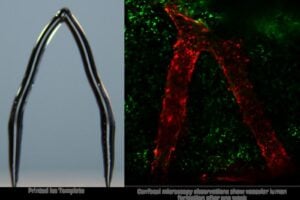
3D ice printing can create artificial blood vessels in engineered tissue

3D ice printing can create artificial blood vessels in engineered tissue

Conceptual art Illustration of DNA in a cell

A novel switch to turn genes on/off on cue

Researchers used two stationary smartphones to record motion capture of study participants. Florent Vial, Stanford Neuromuscular Biomechanics Lab

Smartphone app quickly analyzes human motion to aid physical rehab

Physician reviewing an X-ray of human breast tissue. Courtesy of University of Liverpool.

New approach may help breast cancer treatment

An artistic rendering of lipid nanoparticles showing multiple layers that take on different molecular arrangements, giving the particle varying properties. Jenny Nuss

Breaking Barriers in Drug Delivery with Better Lipid Nanoparticles

A jumbo phage infects a bacterium. A nucleus-like compartment (green) is formed to protect the newly synthesized phage genomes from bacterial defense systems. The capsids (gray) of the new phage travel along filaments called PhuZ (yellow) to be delivered to the nucleus where they dock in order to package phage DNA. Eventually, the bacterial cell lyses and the new phage emerge ready to infect new bacteria. Credit: Margot Riggi, Iwasa Lab, University of Utah. Copyright Elizabeth Villa and Joe Pogliano, UC San Diego

Therapeutic Potential of Bizarre ‘Jumbo’ Viruses Tapped for $10M HHMI Emerging Pathogens Project

Older posts
Page1 Page2 Next →
Substack subscription form sign up

Comments

  • Norwood johnson on Electrons in New Crystals Behave as If They Live in Four Dimensions
  • ScienceBlog.com on Hidden Geometry Could Finally Fix Quantum Computers
  • Theo Prinse on America Is Going Back to the Moon. This Time, It Plans to Stay
  • george w on Hidden Geometry Could Finally Fix Quantum Computers
  • Tom Hughes on Years of Exercise, Blood Pressure Drugs Failed to Slow Cognitive Decline in Seniors at Dementia Risk
© 2026 ScienceBlog.com | Follow our RSS / XML feed