Skip to content
ScienceBlog.com
  • Featured Blogs
    • EU Horizon Blog
    • ESA Tracker
    • Experimental Frontiers
    • Josh Mitteldorf’s Aging Matters
    • Dr. Lu Zhang’s Gondwanaland
    • NeuroEdge
    • NIAAA
    • SciChi
    • The Poetry of Science
    • Wild Science
  • Topics
    • Brain & Behavior
    • Earth, Energy & Environment
    • Health
    • Life & Non-humans
    • Physics & Mathematics
    • Social Sciences
    • Space
    • Technology
  • Our Substack
  • Follow Us!
    • Bluesky
    • Threads
    • FaceBook
    • Google News
    • Twitter/X
  • Contribute/Contact

brain aging

three women ad successively older age

Scientists Identify Critical “Midlife Window” for Preventing Age-Related Brain Decline

sickle cell blood cells

Sickle Cell Disease Ages Brain Years Ahead of Time

primates

Insights from Non-Human Primates Shed Light on Alzheimer’s Resistance

brain illustration

Biomarkers of the middle-aged brain predict cognitive health in old age

A split image showing a vibrant, well-maintained neighborhood on one side and a run-down, disadvantaged neighborhood on the other, with a brain superimposed over both, highlighting the connection between living environment and brain health.

Your Neighborhood May Increase Your Risk of Dementia

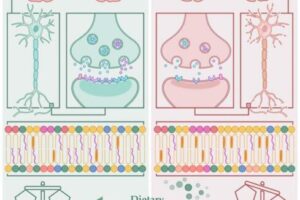
The process of brain aging is distinguished by a gradual deterioration in the functioning of neurons, which can be attributed to an imbalance in the cellular and molecular mechanisms governing synaptic plasticity. Synapses are enriched with various lipid species including phosphatidylcholine, phosphatidylethanolamine, phosphatidylserine, sphingolipids, and some other less abundant components. Those components are altered in aging brain, could affect brain functions, including structural development, nerve-impulse transmission, neurogenesis, synaptogenesis and myelin formation. Dietary phospholipid intervention could prevent brain aging by maintaining lipid homeostasis and enhancing synaptic plasticity.

Dietary fat as potential strategy to prevent brain aging

A study led by Stanford Medicine researchers provides insight into aging of the brain. Adobe Stock/kulkann

Researchers identifies gene ‘fingerprint’ for brain aging

The day’s catch Photo Credit: MICHAEL GURVEN

Too much food tied to brain aging

Substack subscription form sign up

Comments

  • Norwood johnson on Electrons in New Crystals Behave as If They Live in Four Dimensions
  • ScienceBlog.com on Hidden Geometry Could Finally Fix Quantum Computers
  • Theo Prinse on America Is Going Back to the Moon. This Time, It Plans to Stay
  • george w on Hidden Geometry Could Finally Fix Quantum Computers
  • Tom Hughes on Years of Exercise, Blood Pressure Drugs Failed to Slow Cognitive Decline in Seniors at Dementia Risk
© 2026 ScienceBlog.com | Follow our RSS / XML feed