Skip to content
ScienceBlog.com
  • Featured Blogs
    • EU Horizon Blog
    • ESA Tracker
    • Experimental Frontiers
    • Josh Mitteldorf’s Aging Matters
    • Dr. Lu Zhang’s Gondwanaland
    • NeuroEdge
    • NIAAA
    • SciChi
    • The Poetry of Science
    • Wild Science
  • Topics
    • Brain & Behavior
    • Earth, Energy & Environment
    • Health
    • Life & Non-humans
    • Physics & Mathematics
    • Social Sciences
    • Space
    • Technology
  • Our Substack
  • Follow Us!
    • Bluesky
    • Threads
    • FaceBook
    • Google News
    • Twitter/X
  • Contribute/Contact

brain inflammation

Evidence mounts that a long-term diet high in fat is not healthy.

Memory is impaired in aged rats after 3 days of high-fat eating

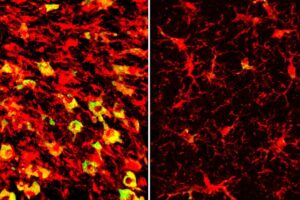
Lipid deposits (green) in brain immune cells (red) from mice with Alzheimer’s-like disease all but disappear (right) after the mice are treated with an experimental drug. Researchers at Washington University School of Medicine in St. Louis have found that a form of cholesterol known as cholesteryl esters builds up in the brains of mice with Alzheimer’s-like disease, and that clearing out the cholesteryl esters helps prevent brain damage and behavioral changes.

Lowering a form of brain cholesterol cuts Alzheimer’s-like damage in mice

Syringe illustration. Pixabay

New vaccine may successfully target Alzheimer’s

Image of a vial of vaccine. Pixabay

Japanese vaccine may hold key to prevent or reduce the impact of Alzheimer’s disease

Man with drink in hand looking stressed out

How heavy alcohol consumption increases brain inflammation

Substack subscription form sign up

Comments

  • Norwood johnson on Electrons in New Crystals Behave as If They Live in Four Dimensions
  • ScienceBlog.com on Hidden Geometry Could Finally Fix Quantum Computers
  • Theo Prinse on America Is Going Back to the Moon. This Time, It Plans to Stay
  • george w on Hidden Geometry Could Finally Fix Quantum Computers
  • Tom Hughes on Years of Exercise, Blood Pressure Drugs Failed to Slow Cognitive Decline in Seniors at Dementia Risk
© 2026 ScienceBlog.com | Follow our RSS / XML feed