Skip to content
ScienceBlog.com
  • Featured Blogs
    • EU Horizon Blog
    • ESA Tracker
    • Experimental Frontiers
    • Josh Mitteldorf’s Aging Matters
    • Dr. Lu Zhang’s Gondwanaland
    • NeuroEdge
    • NIAAA
    • SciChi
    • The Poetry of Science
    • Wild Science
  • Topics
    • Brain & Behavior
    • Earth, Energy & Environment
    • Health
    • Life & Non-humans
    • Physics & Mathematics
    • Social Sciences
    • Space
    • Technology
  • Our Substack
  • Follow Us!
    • Bluesky
    • Threads
    • FaceBook
    • Google News
    • Twitter/X
  • Contribute/Contact

Brain Research

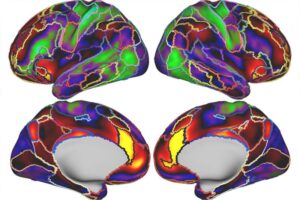
The image displays four views of a person's brain, highlighting the boundaries between different functional brain networks, each represented by different colored lines, as mapped using functional MRI. This map is overlaid on a salience network connectivity heat map, where warmer colors indicate stronger connectivity within the salience network. Researchers discovered that a larger salience network may be associated with an increased risk of depression. Credit: Lynch/Liston Labs.

Brain Scans Reveal Neuronal ‘Wiring’ Linked to Depression Risk

Research Reveals Common Genetic Basis for Problematic Alcohol Use

Brain Changes During Alcohol Recovery May Contribute to Anxiety and Relapse, Study Finds

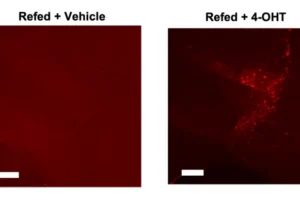
The parasubthalamic neurons sensitive to binge eating, shown in red, reduce the eagerness of mice to start eating.

Brain Cells That Control Your First Bite: New Discovery Could Impact Eating Disorders

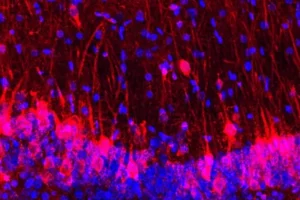
Mouse hippocampus with rat cells

Scientists Create Mice with Rat-Mouse Hybrid Brains

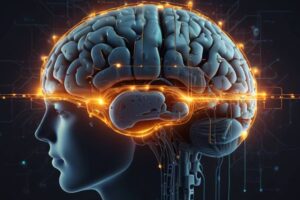
An illustration depicting a human brain with digital circuits and connections overlaid on it, representing the integration of neuroscience and computing.

Digital Neuroscience Poised for Breakthrough Advances

Brain drawing

Scientists Uncover Brain Cells’ Coordination of Focus and Short-Term Memory Storage

Researchers from the Institute of Industrial Science, The University of Tokyo, find that providing lab-grown ‘cerebral organoids’ with connections similar to those in real brains enhances their development and activity

Scientists Grow Brain-Like Tissue with Complex Connections in a Dish

Researchers using non-invasive neuromodulation, a technique that has shown promising results in reducing symptoms of depression, Alzheimer’s disease, and Parkinson’s disease.

Breakthrough in Brain Stimulation: Scientists Discover New Way to Modulate Behavior

A_person_cowering_in_fear_with_a_thought_bubble_showin_0

How stress turns into fear in the brain

brain wave illustration

Research on Gamma Stimulation Offers Promising Insights into Alzheimer’s Treatment

Statue of a voluptuous woman. Pixabay.

Brain’s ‘appetite control centre’ different in people who are overweight or living with obesity

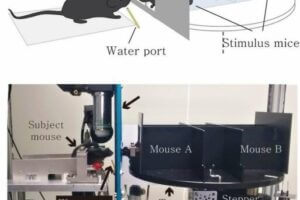
One of the two immobilized mice is presented to the subject mouse in random order. The subject mouse learns to recognize the presented mouse and associates it with the availability of water reward.

Scientists Discover Neurons Responsible for Individual Recognition in the Brain

Man with face in hand

Genetic Variant Offers Protection Against Alzheimer’s Disease

Two children reading in the woods

Two brain networks are activated while reading

Older posts
Page1 Page2 Next →
Substack subscription form sign up

Comments

  • Brunette Keller on How New Herpes Drugs Jam a Virus’s Replication Engine
  • Aizen on Laziness helped lead to extinction of Homo erectus
  • Norwood johnson on Electrons in New Crystals Behave as If They Live in Four Dimensions
  • ScienceBlog.com on Hidden Geometry Could Finally Fix Quantum Computers
  • Theo Prinse on America Is Going Back to the Moon. This Time, It Plans to Stay
© 2026 ScienceBlog.com | Follow our RSS / XML feed