Skip to content
ScienceBlog.com
  • Featured Blogs
    • EU Horizon Blog
    • ESA Tracker
    • Experimental Frontiers
    • Josh Mitteldorf’s Aging Matters
    • Dr. Lu Zhang’s Gondwanaland
    • NeuroEdge
    • NIAAA
    • SciChi
    • The Poetry of Science
    • Wild Science
  • Topics
    • Brain & Behavior
    • Earth, Energy & Environment
    • Health
    • Life & Non-humans
    • Physics & Mathematics
    • Social Sciences
    • Space
    • Technology
  • Our Substack
  • Follow Us!
    • Bluesky
    • Threads
    • FaceBook
    • Google News
    • Twitter/X
  • Contribute/Contact

carbon dioxide conversion

Tiny copper ‘nano-flowers’ have been attached to an artificial leaf to produce clean fuels and chemicals that are the backbone of modern energy and manufacturing.

Microscopic Copper Gardens Turn CO2 Into Clean Fuel

Scientists have devised a strategy for converting carbon dioxide (CO2) from the atmosphere into valuable carbon nanofibers. The process uses tandem electrocatalytic (blue ring) and thermocatalytic (orange ring) reactions to convert the CO2 (teal and silver molecules) plus water (purple and teal) into "fixed" carbon nanofibers (silver), producing hydrogen gas (H2, purple) as a beneficial byproduct. The carbon nanofibers could be used to strengthen building materials such as cement and lock away carbon for decades.

Catalytic combo converts CO2 to solid carbon nanofibers

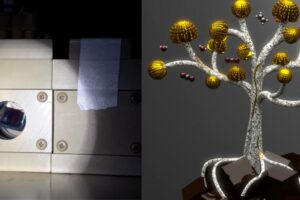
Photo montage of catalytic process

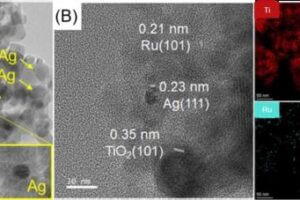
High-efficiency catalysts convert atmospheric CO2 into fuel

Substack subscription form sign up

Comments

  • Ran on How the Age You First Had Sex Could Shape How You Age Decades Later
  • Sparty on How the Age You First Had Sex Could Shape How You Age Decades Later
  • Josh Mitteldorf on A Single TV Segment Sent Leucovorin Prescriptions for Autistic Children Soaring 2,000 Percent
  • Josh Mitteldorf on A Single TV Segment Sent Leucovorin Prescriptions for Autistic Children Soaring 2,000 Percent
  • Josh Mitteldorf on A Pill That Keeps Your Throat Awake Could Transform Sleep Apnea Treatment
© 2026 ScienceBlog.com | Follow our RSS / XML feed