Skip to content
ScienceBlog.com
  • Featured Blogs
    • EU Horizon Blog
    • ESA Tracker
    • Experimental Frontiers
    • Josh Mitteldorf’s Aging Matters
    • Dr. Lu Zhang’s Gondwanaland
    • NeuroEdge
    • NIAAA
    • SciChi
    • The Poetry of Science
    • Wild Science
  • Topics
    • Brain & Behavior
    • Earth, Energy & Environment
    • Health
    • Life & Non-humans
    • Physics & Mathematics
    • Social Sciences
    • Space
    • Technology
  • Our Substack
  • Follow Us!
    • Bluesky
    • Threads
    • FaceBook
    • Google News
    • Twitter/X
  • Contribute/Contact

carbon dioxide

The clearest look in the infrared yet at the iconic multi-planet system HR 8799. Colors are applied to filters from Webb’s NIRCam (Near-Infrared Camera). A star symbol marks the location of the host star HR 8799, whose light has been blocked by the coronagraph. In this image, the color blue is assigned to 4.1 micron light, green to 4.3 micron light, and red to the 4.6 micron light

Webb Spies First Direct Images of CO2 Outside Solar System

Ohio State logo

Turning carbon emissions into methane fuel

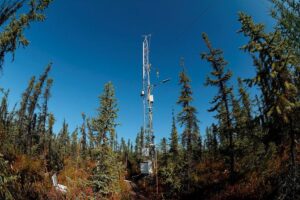
The tower installed in a black spruce forest on permafrost in Fairbanks, Alaska, monitors CO2 exchange and environmental conditions in 30-minute intervals.

20-Year Study Reveals Surprising Climate Change Effects on Permafrost Forests

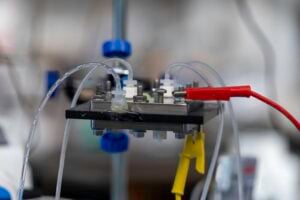
Reactor prototype. Credit Photo by Gustavo Raskoksy/Rice University.

New reactor could make direct air capture more energy efficient

Ohio State logo

Chemists design novel method for generating sustainable fuel

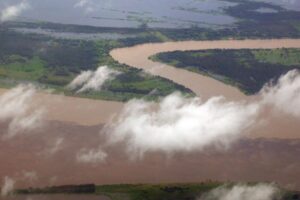
The Amazon, Earth’s largest river, transporting weathering solutes from the Andes to the Atlantic Ocean in Brazil. Credit: J. Gaillardet, Institut de Physique du Globe de Paris. All Rights Reserved.

How ‘Earth’s thermostat’ controls climate

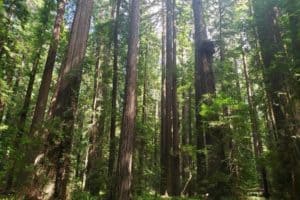
Redwood forests such as this one in California's Humboldt County are key components of the state's climate change mitigation efforts, but UCI researchers suggest that ongoing greenhouse gas emissions may limit the ability of trees to remove carbon dioxide from the atmosphere.

Forest trees find a new watery ‘sweet spot’ when CO2 is high

Substack subscription form sign up

Comments

  • Norwood johnson on Electrons in New Crystals Behave as If They Live in Four Dimensions
  • ScienceBlog.com on Hidden Geometry Could Finally Fix Quantum Computers
  • Theo Prinse on America Is Going Back to the Moon. This Time, It Plans to Stay
  • george w on Hidden Geometry Could Finally Fix Quantum Computers
  • Tom Hughes on Years of Exercise, Blood Pressure Drugs Failed to Slow Cognitive Decline in Seniors at Dementia Risk
© 2026 ScienceBlog.com | Follow our RSS / XML feed