Skip to content
ScienceBlog.com
  • Featured Blogs
    • EU Horizon Blog
    • ESA Tracker
    • Experimental Frontiers
    • Josh Mitteldorf’s Aging Matters
    • Dr. Lu Zhang’s Gondwanaland
    • NeuroEdge
    • NIAAA
    • SciChi
    • The Poetry of Science
    • Wild Science
  • Topics
    • Brain & Behavior
    • Earth, Energy & Environment
    • Health
    • Life & Non-humans
    • Physics & Mathematics
    • Social Sciences
    • Space
    • Technology
  • Our Substack
  • Follow Us!
    • Bluesky
    • Threads
    • FaceBook
    • Google News
    • Twitter/X
  • Contribute/Contact

chemistry

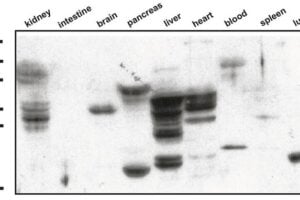
The dark bands correspond to EKODE products in mouse tissues, including liver, pancreas and heart. Unique compounds and concentrations are found in different tissues and organs, which could lead to blood tests for disease-specific biomarkers.

Novel Blood Test Could Reveal Hidden Inflammation in Heart Disease and Alzheimer’s

Marine Dinoflagellate Amphidinium sp.

Natural Cancer-Fighting Compound’s Structure Finally Revealed After Decade-Long Quest

Ohio State logo

Scientists develop novel method for strengthening PVC products

Ohio State logo

Ohio State professor named Blavatnik National Awards finalist

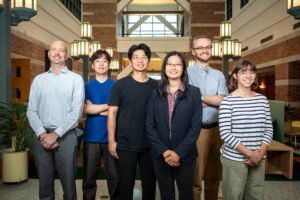
Illinois researchers have opened up the AI "black box" to gain valuable new insight about chemistry for solar energy applications. Pictured, from left: Professor Charles Schroeder, graduate students Changhyun Hwang and Seungjoo Yi, professor Ying Diao, professor Nick Jackson and graduate student Tiara Torres Flores. Photo by Michelle Hassel

AI Unveils Chemical Secrets for Solar Energy: Turning the Black Box Transparent

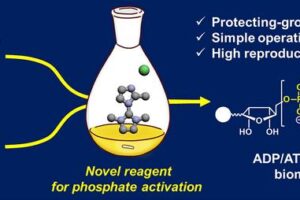
Researchers used a novel phosphate-activation reagent, 2-MeImIm-Cl, in an improved coupling reaction to increase the yield of ADP- or ATP-containing molecules. Unlike traditional reactions, the modified coupling reaction does not require protecting groups, is simple to perform and exhibits high reproducibility.

Chemists Unlock Efficient Way to Create Cellular Energy Molecules

Ohio State logo

Chemists design novel method for generating sustainable fuel

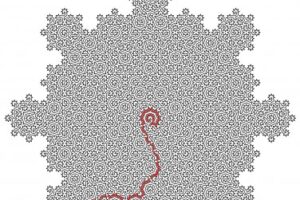
Image shows one possible solution exiting the simpler of the two mazes.

Scientists create world’s most amazingly difficult maze with future potential to boost carbon capture

The study found that negatively charged silica microparticles suspended in water attracted each other to form hexagonally arranged clusters. Image credit: Cover image: Zhang Kang.

It’s not only opposites that attract – new study shows like-charged particles can come together

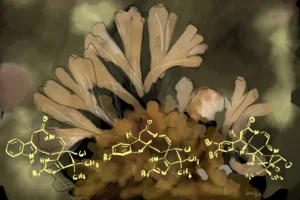
The marine bryozoan Securiflustra securifrons with representative natural product isolates securine A, securamine B, and securamine I. (Digital art by Vaani Gupta)

Chemists synthesize unique anticancer molecules using novel approach

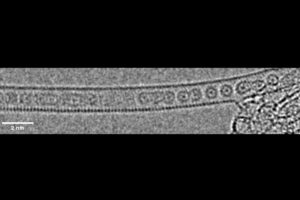
Still image of trapped gas atoms

Scientists trap krypton atoms to form one-dimensional gas

Digital Molecular Structure Concept Credit: BlackJack3D via Getty Images

Accelerating how new drugs are made with machine learning

Sunrise over Venus Credit: FreelanceImages/Universal Images Group/Science Photo Library via Getty Images

Mysterious missing component in the clouds of Venus revealed

methane reactor

“Methane cleaner” could become a permanent fixture in cattle and pig barns

Older posts
Page1 Page2 Next →
Substack subscription form sign up

Comments

  • Norwood johnson on Electrons in New Crystals Behave as If They Live in Four Dimensions
  • ScienceBlog.com on Hidden Geometry Could Finally Fix Quantum Computers
  • Theo Prinse on America Is Going Back to the Moon. This Time, It Plans to Stay
  • george w on Hidden Geometry Could Finally Fix Quantum Computers
  • Tom Hughes on Years of Exercise, Blood Pressure Drugs Failed to Slow Cognitive Decline in Seniors at Dementia Risk
© 2026 ScienceBlog.com | Follow our RSS / XML feed