Skip to content
ScienceBlog.com
  • Featured Blogs
    • EU Horizon Blog
    • ESA Tracker
    • Experimental Frontiers
    • Josh Mitteldorf’s Aging Matters
    • Dr. Lu Zhang’s Gondwanaland
    • NeuroEdge
    • NIAAA
    • SciChi
    • The Poetry of Science
    • Wild Science
  • Topics
    • Brain & Behavior
    • Earth, Energy & Environment
    • Health
    • Life & Non-humans
    • Physics & Mathematics
    • Social Sciences
    • Space
    • Technology
  • Our Substack
  • Follow Us!
    • Bluesky
    • Threads
    • FaceBook
    • Google News
    • Twitter/X
  • Contribute/Contact

Cosmic Dawn

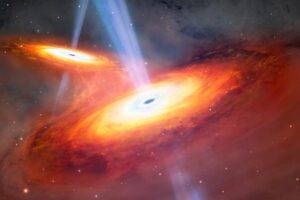
This illustration depicts two quasars in the process of merging. Using both the Gemini North telescope, one half of the International Gemini Observatory, which is supported in part by the U.S. National Science Foundation and operated by NSF NOIRLab, and the Subaru Telescope, a team of astronomers have discovered a pair of merging quasars seen only 900 million years after the Big Bang. Not only is this the most distant pair of merging quasars ever found, but also the first confirmed pair found in the period of the Universe known as Cosmic Dawn.

Astronomers Discover Earliest Known Pair of Merging Quasars, Shedding Light on Cosmic Dawn

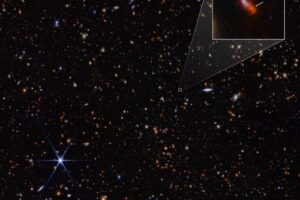
infrared image from NASA’s James Webb Space Telescope (JWST)

Astronomers Uncover Surprisingly Massive Galaxy from the Dawn of the Universe

University of Michigan astronomer Sally Oey studied a star-forming region in host galaxy, NGC 2366, which is a typical dwarf irregular galaxy. Image courtesy: Observatorio de Calar Alto, J. van Eymeren (AIRUB, ATNF) & Á.R. López-Sánchez

Dwarf galaxies use 10-million-year quiet period to churn out stars

Artist conception of early starbursting galaxies. The image is rendered from FIRE simulation data used for this research that can explain recent JWST results. Stars and galaxies are shown in the bright white points of light, while the more diffuse dark matter and gas are shown in purples and reds.

Bursts of star formation explain mysterious brightness at cosmic dawn

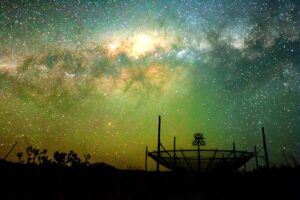
The HERA radio telescope, located in Karoo in South Africa, consists of 350 dishes pointed upward to detect radio waves from the early universe.

How different were galaxies in the early universe?

Substack subscription form sign up

Comments

  • Booklet AI on Key to online education: Test early and often
  • Karoly Mirnics on Common Prescription Drugs May Disrupt Cholesterol Pathways in the Womb and Raise Autism Risk
  • Aizen on Laziness helped lead to extinction of Homo erectus
  • Norwood johnson on Electrons in New Crystals Behave as If They Live in Four Dimensions
  • ScienceBlog.com on Hidden Geometry Could Finally Fix Quantum Computers
© 2026 ScienceBlog.com | Follow our RSS / XML feed