Skip to content
ScienceBlog.com
  • Featured Blogs
    • EU Horizon Blog
    • ESA Tracker
    • Experimental Frontiers
    • Josh Mitteldorf’s Aging Matters
    • Dr. Lu Zhang’s Gondwanaland
    • NeuroEdge
    • NIAAA
    • SciChi
    • The Poetry of Science
    • Wild Science
  • Topics
    • Brain & Behavior
    • Earth, Energy & Environment
    • Health
    • Life & Non-humans
    • Physics & Mathematics
    • Social Sciences
    • Space
    • Technology
  • Our Substack
  • Follow Us!
    • Bluesky
    • Threads
    • FaceBook
    • Google News
    • Twitter/X
  • Contribute/Contact

Dark Spot

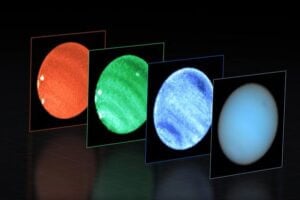
This image shows Neptune observed with the MUSE instrument at ESO’s Very Large Telescope (VLT). At each pixel within Neptune, MUSE splits the incoming light into its constituent colours or wavelengths. This is similar to obtaining images at thousands of different wavelengths all at once, which provides a wealth of valuable information to astronomers. The image to the right combines all colours captured by MUSE into a “natural” view of Neptune, where a dark spot can be seen to the upper-right. Then we see images at specific wavelengths: 551 nanometres (blue), 831 nm (green), and 848 nm (red); note that the colours are only indicative, for display purposes. The dark spot is most prominent at shorter (bluer) wavelengths. Right next to this dark spot MUSE also captured a small bright one, seen here only in the middle image at 831 nm and located deep in the atmosphere. This type of deep bright cloud had never been identified before on the planet. The images also show several other shallower bright spots towards the bottom-left edge of Neptune, seen at long wavelengths. Imaging Neptune’s dark spot from the ground was only possible thanks to the VLT’s Adaptive Optics Facility, which corrects the blur caused by atmospheric turbulence and allows MUSE to obtain crystal clear images. To better highlight the subtle dark and bright features on the planet, the astronomers carefully processed the MUSE data, obtaining what you see here.

Mysterious Neptune dark spot detected from Earth for the first time

Substack subscription form sign up

Comments

  • Sue Ann Hayes on Hidden Nuclear Protein Fuels Pancreatic Cancer’s Deadly Aggression
  • Curtis Webber on The GPS-Killer? This Quantum Device ‘Feels’ Motion Like a Brain—Down to the Atomic Level
  • Ran on How the Age You First Had Sex Could Shape How You Age Decades Later
  • Sparty on How the Age You First Had Sex Could Shape How You Age Decades Later
  • Josh Mitteldorf on A Single TV Segment Sent Leucovorin Prescriptions for Autistic Children Soaring 2,000 Percent
© 2026 ScienceBlog.com | Follow our RSS / XML feed