Skip to content
ScienceBlog.com
  • Featured Blogs
    • EU Horizon Blog
    • ESA Tracker
    • Experimental Frontiers
    • Josh Mitteldorf’s Aging Matters
    • Dr. Lu Zhang’s Gondwanaland
    • NeuroEdge
    • NIAAA
    • SciChi
    • The Poetry of Science
    • Wild Science
  • Topics
    • Brain & Behavior
    • Earth, Energy & Environment
    • Health
    • Life & Non-humans
    • Physics & Mathematics
    • Social Sciences
    • Space
    • Technology
  • Our Substack
  • Follow Us!
    • Bluesky
    • Threads
    • FaceBook
    • Google News
    • Twitter/X
  • Contribute/Contact

data transmission

The proposed vortex beam can carry vast amounts of information, making them ideal for dense data communication systems.

Novel Light-Bending Technology Could Transform Data Security and Transmission

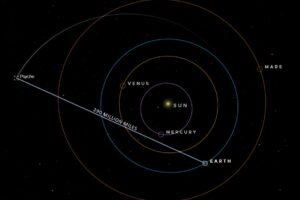
This visualization shows Psyche’s position on July 29 when the uplink station for NASA’s Deep Space Optical Communications sent a laser signal about 290 million miles to the spacecraft. See an interactive version of the Psyche spacecraft in NASA’s Eyes on the Solar System. Credit: NASA/JPL-Caltech

NASA’s Laser Communication Breaks Distance Record, Paving Way for Future Space Exploration

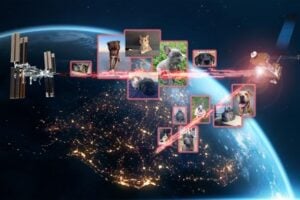
A collage of the pet photos sent over laser links from Earth to LCRD (Laser Communications Relay Demonstration) to ILLUMA-T (Integrated LCRD Low Earth Orbit User Modem and Amplifier Terminal) on the space station. Animals submitted include cats, dogs, birds, chickens, cows, snakes, pigs, and more.

NASA’s Laser Relay System Transmits Pet Photos at Lightning Speed

Substack subscription form sign up

Comments

  • Karoly Mirnics on Common Prescription Drugs May Disrupt Cholesterol Pathways in the Womb and Raise Autism Risk
  • Aizen on Laziness helped lead to extinction of Homo erectus
  • Norwood johnson on Electrons in New Crystals Behave as If They Live in Four Dimensions
  • ScienceBlog.com on Hidden Geometry Could Finally Fix Quantum Computers
  • Theo Prinse on America Is Going Back to the Moon. This Time, It Plans to Stay
© 2026 ScienceBlog.com | Follow our RSS / XML feed