Skip to content
ScienceBlog.com
  • Featured Blogs
    • EU Horizon Blog
    • ESA Tracker
    • Experimental Frontiers
    • Josh Mitteldorf’s Aging Matters
    • Dr. Lu Zhang’s Gondwanaland
    • NeuroEdge
    • NIAAA
    • SciChi
    • The Poetry of Science
    • Wild Science
  • Topics
    • Brain & Behavior
    • Earth, Energy & Environment
    • Health
    • Life & Non-humans
    • Physics & Mathematics
    • Social Sciences
    • Space
    • Technology
  • Our Substack
  • Follow Us!
    • Bluesky
    • Threads
    • FaceBook
    • Google News
    • Twitter/X
  • Contribute/Contact

deep

Seabugs

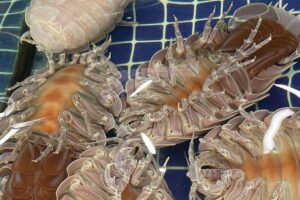
Deep-Sea ‘Darth Vader’ Bug Becomes Vietnam’s Latest Seafood Craze

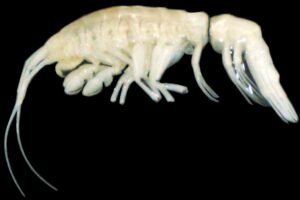
The newly discovered crustacean Ducibella camanchaca is the first large, active predatory amphipod from the extreme depths of Atacama Trench.

Team Discovers New Ocean Predator

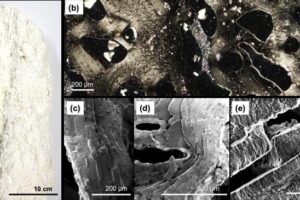
a) Photograph of HV precipitates collected from the Shinkai Seep Field. b) Cross-polarized optical microscope images of precipitates in cross section. c,d) Scanning electron images showing layers within the precipitates. f) Magnification showing sublayers in the boxed area of d.

Deep Ocean Nanostructures Offer Clues to Life’s Origins and Future Energy Solutions

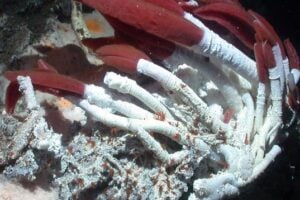
Riftia pachiyptila

Giant deep-sea vent tubeworm symbionts use two carbon fixation pathways to grow at record speeds

A team led by researchers at the University of Washington has developed deep-learning algorithms that let users pick which sounds filter through their headphones in real time. Pictured is co-author Malek Itani demonstrating the system.University of Washington

New AI noise-canceling headphone technology lets wearers pick which sounds they hear

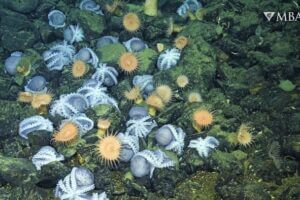
An aggregation of female pearl octopus (Muusoctopus robustus) nesting at the Octopus Garden, located near Davidson Seamount off the Central California at a depth of approximately 3,200 meters. Researchers used MBARI's advanced technology to confirm pearl octopus gather at the Octopus Garden to mate and nest. Warm water from hydrothermal springs accelerates development of octopus embryos, giving young octopus a better chance of survival.

Why thousands of octopus migrate to deep-sea thermal springs

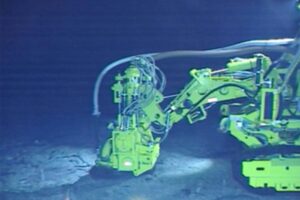
A green robot arm

Echoes from the Deep

Innovation in Europe – the secrets to entrepreneurial success and the importance of “patient capital”

A selection of deep-sea specimens from the museum’s collection. - Trustees of the Natural History Museum London

Urgent Need to Protect Deep-Sea Species Amidst Impending Mining Activities

A view of the Normand Energy deploying the Patania II nodule collector visible (green), seen from the Rainbow Warrior. The vessel is chartered by Global Sea Mineral Resources (GSR), a Belgian company researching deep sea mining in the Pacific. The company is currently testing mining gear with the aim of future commercial extraction of minerals from the seabed.

Whale warning as clock ticks towards deep-sea mining

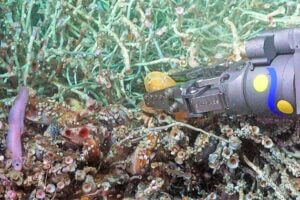
The light purple fish in the lower left of this photo is Pyrolycus jaco, a newly identified species of eelpout. It’s shown here among mussels and tubeworms at the Jacó Scar hydrothermal seep. Image credit: ROV SuBastian/Schmidt Ocean Institute

New Species of Deep-Sea Fish Discovered off Costa Rica

Substack subscription form sign up

Comments

  • Karoly Mirnics on Common Prescription Drugs May Disrupt Cholesterol Pathways in the Womb and Raise Autism Risk
  • Aizen on Laziness helped lead to extinction of Homo erectus
  • Norwood johnson on Electrons in New Crystals Behave as If They Live in Four Dimensions
  • ScienceBlog.com on Hidden Geometry Could Finally Fix Quantum Computers
  • Theo Prinse on America Is Going Back to the Moon. This Time, It Plans to Stay
© 2026 ScienceBlog.com | Follow our RSS / XML feed