Skip to content
ScienceBlog.com
  • Featured Blogs
    • EU Horizon Blog
    • ESA Tracker
    • Experimental Frontiers
    • Josh Mitteldorf’s Aging Matters
    • Dr. Lu Zhang’s Gondwanaland
    • NeuroEdge
    • NIAAA
    • SciChi
    • The Poetry of Science
    • Wild Science
  • Topics
    • Brain & Behavior
    • Earth, Energy & Environment
    • Health
    • Life & Non-humans
    • Physics & Mathematics
    • Social Sciences
    • Space
    • Technology
  • Our Substack
  • Follow Us!
    • Bluesky
    • Threads
    • FaceBook
    • Google News
    • Twitter/X
  • Contribute/Contact

dementia

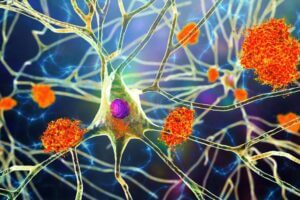
Neurons. Alzheimer’s disease varies widely in its age of onset, presentation, and severity. Recently, the SORL1 gene has received increased attention since variations in this gene have been associated with both early- and late-onset Alzheimer’s. However, little is known about how damage to SORL1 leads to disease. Using stem cells from patients with Alzheimer’s, investigators from Harvard-affiliated Brigham and Women’s Hospital found that loss of normal SORL1 function leads to a reduction in two key proteins known to be involved in Alzheimer’s and which play an essential role in the neurons of healthy individuals. Their results, published in Cell Reports, suggest a potential strategy for Alzheimer’s disease treatment, especially for patients not responsive to existing therapies. In this new study, the researchers utilized a stem-cell based approach that examined natural genetic variability in Alzheimer’s patients to gain insight into an alternative pathway driving disease. The researchers used CRISPR technologies to remove the SORL1 gene from progenitor stem cells, derived from participants in two Alzheimer’s research cohorts, the Religious Order Studies and Rush Memory and Aging Project. They then programmed the stem cells to differentiate into four different kinds of brain cells to examine the impact of removing SORL1 on each cell type. The most dramatic impact was seen in neurons and a “support” cell in the brain (astrocytes). Neurons lacking SORL1 demonstrated especially prominent reduction in the levels of two key Alzheimer’s disease proteins: APOE and CLU. Without APOE and CLU, neurons cannot properly regulate lipids, which accumulate in droplets that may impair neurons’ abilities to communicate with each other. The researchers verified their lab-based results by examining natural genetic variation in SORL1 expression in the brain tissue of 50 members of the cohorts, finding again that lower SORL1 activity in neurons was correlated with reduced APOE and CLU in these people. Historically, researchers have studied three potent genetic drivers of Alzheimer’s disease (APP, PSEN1 and PSEN2), which are commonly mutated in hereditary, early-onset Alzheimer’s (AD diagnosis before age 65). Preclinical models and cell-based systems largely rely on mutations in these genes to model Alzheimer’s disease, even though in many people with late-onset (“sporadic”) Alzheimer’s, a more complex interaction between genes, lifestyle, and environment determines the presentation of the disease. Key neurological features of Alzheimer’s disease, including the abundance of amyloid-beta plaques in the brain, also vary across individuals. “Our study is one of the first with human cells from a large collection of individuals to try to understand the ‘molecular road’ that starts with SORL1, which we now see converges with APOE,” said corresponding author Tracy Young-Pearse of the Ann Romney Center for Neurological Diseases. “Our research points to the importance of developing interventions that target these and other molecular roads to Alzheimer’s disease. The more we can understand subtype-specific differences in AD, the better we will be able to design rational therapeutic interventions to try to fix the problem that is primarily driving disease in each patient.” The researchers are continuing to study other pathways that may lead to Alzheimer’s disease, such as those involving microglia (brain cells that perform immune functions). By using study models and techniques reflective of Alzheimer’s disease presentation in the general population, the researchers hope to identify additional biological pathways important in Alzheimer’s disease. In addition, Brigham researchers have played a leadership role in understanding the molecular and genetic basis for Alzheimer’s disease, including making key discoveries related to the amyloid protein. Two novel anti-amyloid therapies, aducanumab and lecanemab, have received U.S. Food and Drug Administration accelerated and traditional approval, respectively, but not all patients respond to these drugs, warranting other treatment options. This work was supported by the National Institutes of Health (F31AG063399, U01AG072572, U01AG061356, RF1NS117446 and R01AG055909).

Study Unveils Shared Cellular Mechanisms in Major Dementias

lewy body

Alzheimer’s drug may slow down cognitive decline in dementia with Lewy bodies

middle aged man looking perplexed

Study Links Declining Sense of Purpose to Mild Cognitive Impairment

three women with their backs to us walking down a trail

Menopause Symptoms May Impact Brain Health, Study Finds

elderly white woman

New Study Identifies 14 Risk Factors for Dementia, Including Two Previously Unknown

A computer screen shows results from an electroencephalogram, or EEG test.

AI boosts the power of EEGs, enabling neurologists to quickly, precisely pinpoint signs of dementia

Red blood cells

Blood Tests Show Promise for Early Dementia Detection

Richard Kazibwe, M.D., assistant professor of internal medicine at Wake Forest University School of Medicine

Vigorous Exercise More Than Once a Week May Lower Dementia Risk in People with High Blood Pressure

a old woman in a hospital bed and wearing a hospital gown, sitting up and smiling

Shedding Light on Lucid Moments in Late-Stage Dementia Patients

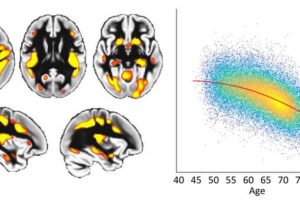
Image caption: To the left of the figure, the red-yellow colour denotes the regions that degenerate earlier than the rest of the brain, and are vulnerable to Alzheimer’s disease. These brain areas are higher-order regions that process and combine information coming from our different senses. To the right of the figure, each dot represents the brain data from one UK Biobank participant. The overall curve shows that, in these particularly fragile regions of the brain, there is accelerated degeneration with age. Credit: G. Douaud and J. Manuello.

Researchers Identify Top Dementia Risk Factors

An illustration depicting a diverse group of adults engaged in conversation, emphasizing various speech speeds.

May I have a quick word? Study shows talking faster is linked to better brain health as we age

Ohio State logo

Helping caregivers help people with dementia eat at home

elderly white woman

Risk of dementia was nearly three times higher the first year after a stroke

Dajiang Zhu, an associate professor in computer science and engineering at UTA

New tool helps predict progression of Alzheimer’s

Older posts
Newer posts
← Previous Page1 Page2 Page3 … Page5 Next →
Substack subscription form sign up

Comments

  • Karoly Mirnics on Common Prescription Drugs May Disrupt Cholesterol Pathways in the Womb and Raise Autism Risk
  • Aizen on Laziness helped lead to extinction of Homo erectus
  • Norwood johnson on Electrons in New Crystals Behave as If They Live in Four Dimensions
  • ScienceBlog.com on Hidden Geometry Could Finally Fix Quantum Computers
  • Theo Prinse on America Is Going Back to the Moon. This Time, It Plans to Stay
© 2026 ScienceBlog.com | Follow our RSS / XML feed