Skip to content
ScienceBlog.com
  • Featured Blogs
    • EU Horizon Blog
    • ESA Tracker
    • Experimental Frontiers
    • Josh Mitteldorf’s Aging Matters
    • Dr. Lu Zhang’s Gondwanaland
    • NeuroEdge
    • NIAAA
    • SciChi
    • The Poetry of Science
    • Wild Science
  • Topics
    • Brain & Behavior
    • Earth, Energy & Environment
    • Health
    • Life & Non-humans
    • Physics & Mathematics
    • Social Sciences
    • Space
    • Technology
  • Our Substack
  • Follow Us!
    • Bluesky
    • Threads
    • FaceBook
    • Google News
    • Twitter/X
  • Contribute/Contact

Earth science

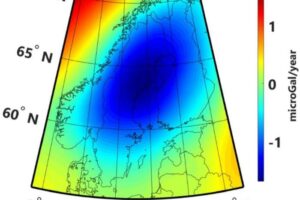
The plot shows the gravity change in Fennoscandia obtained by satellite gravimetry mission (GRACE mission) and a land uplift model. The unit is microGal/year. The gal is defined as 1 centimeter per second squared (1 cm/s2).

Ice Age Aftermath: Nordic Land Mass Rising as Earth’s Gravity Shifts

It's doughnuts all the way down astronaut meme

Scientists Uncover Mysterious ‘Doughnut’ Structure in Earth’s Core

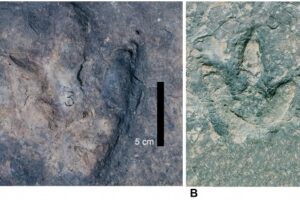
Two representative theropod tracks from the Koum Basin in northern Cameroon.

Dinosaur Footprints Reveal Ancient Continental Connection Between South America and Africa

A view of Garbh Eileach, the largest island in the Garvellach island chain where the gradational transition into snowball Earth is recorded.

Ancient Scottish and Irish Rocks Unveil Earth’s Icy Past, Shaping Life as We Know It

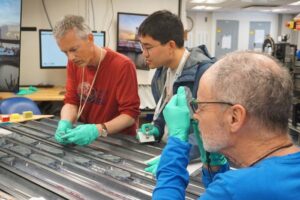
Caption: Professor Johan Lissenberg (left) and colleagues analysing the cores, which were recovered from a “tectonic window” on the Mid-Atlantic Ridge.

Record-Breaking Mantle Rock Recovery Offers New Insights into Earth’s History

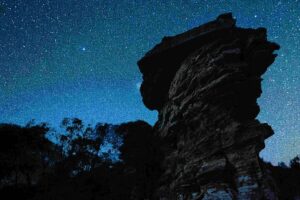
night sky with old rocks in foreground

Oldest Rocks on Earth Challenge Theories of Early Life

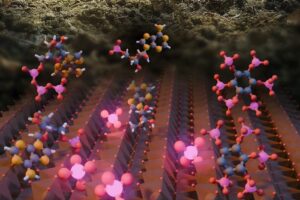
Illustration of phosphorus cleavage from different biomolecules on the surface of natural iron oxide particles.

Iron Oxide Minerals Reshape Our Understanding of Earth’s Phosphorus Cycle

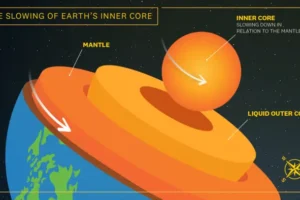
The inner core began to decrease its speed around 2010, moving slower than the Earth’s surface.

Earth’s Inner Core Slows Its Spin, Surprising Scientists

A dynamic illustration of the Earth's magnetic field, with a subtle background of cosmic radiation and charged particles. The image could feature a globe with magnetic field lines and a few cosmic rays penetrating the atmosphere.

Earth’s Weakening Magnetic Field Could Lead to Increased Cosmic Radiation

Earth seen in space

Earth’s Oxygen Evolution Unraveled: Key Insights for Assessing Life on Other Planets

The Welsh countryside near the Coed Cochion Quarry, where the fossils were found. Picture: Anthony Clarke

Key moment in the evolution of life on Earth captured in fossils

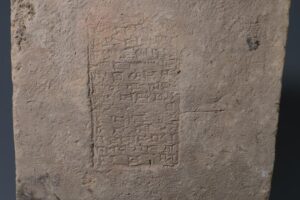
Mesopotamian brick

Mesopotamian bricks unveil the strength of Earth’s ancient magnetic field

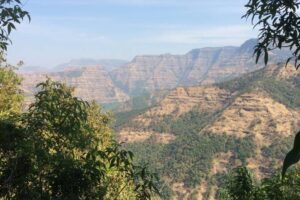
Valleys

More than a meteorite: The new clues about the demise of dinosaurs

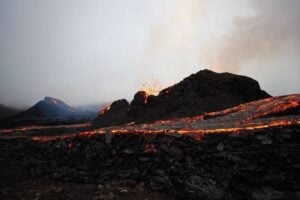
The Fagradalsfjall landscape in Iceland

Listen to Iceland’s recent seismic activity

Older posts
Page1 Page2 Next →
Substack subscription form sign up

Comments

  • Karoly Mirnics on Common Prescription Drugs May Disrupt Cholesterol Pathways in the Womb and Raise Autism Risk
  • Aizen on Laziness helped lead to extinction of Homo erectus
  • Norwood johnson on Electrons in New Crystals Behave as If They Live in Four Dimensions
  • ScienceBlog.com on Hidden Geometry Could Finally Fix Quantum Computers
  • Theo Prinse on America Is Going Back to the Moon. This Time, It Plans to Stay
© 2026 ScienceBlog.com | Follow our RSS / XML feed