Skip to content
ScienceBlog.com
  • Featured Blogs
    • EU Horizon Blog
    • ESA Tracker
    • Experimental Frontiers
    • Josh Mitteldorf’s Aging Matters
    • Dr. Lu Zhang’s Gondwanaland
    • NeuroEdge
    • NIAAA
    • SciChi
    • The Poetry of Science
    • Wild Science
  • Topics
    • Brain & Behavior
    • Earth, Energy & Environment
    • Health
    • Life & Non-humans
    • Physics & Mathematics
    • Social Sciences
    • Space
    • Technology
  • Our Substack
  • Follow Us!
    • Bluesky
    • Threads
    • FaceBook
    • Google News
    • Twitter/X
  • Contribute/Contact

Earth Sciences

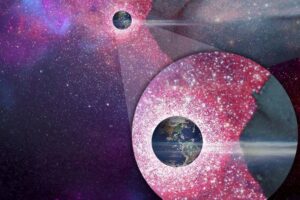
For a brief period of time millions of years ago, Earth may have been plunged out of the sun’s protective plasma shield, called the heliosphere, which is depicted here as the dark gray bubble over the backdrop of interstellar space. According to new research, this could have exposed Earth to high levels of radiation and influenced the climate. Photo courtesy of Opher, et al., Nature Astronomy

Earth’s Climate May Be Shaped by the Sun’s Galactic Journey

Illustration of heating earth

Increased temperature difference between day and night can affect all life on earth

Flood warnings for Africa advance with EU expertise

Earthquake illustration. Pixabay.

Intriguing Correlation Found Between Earthquakes and Cosmic Radiation

Parched California land

Using satellites to track groundwater depletion in California

Ohio State logo

Using deep learning to monitor India’s disappearing forest cover

Substack subscription form sign up

Comments

  • Norwood johnson on Electrons in New Crystals Behave as If They Live in Four Dimensions
  • ScienceBlog.com on Hidden Geometry Could Finally Fix Quantum Computers
  • Theo Prinse on America Is Going Back to the Moon. This Time, It Plans to Stay
  • george w on Hidden Geometry Could Finally Fix Quantum Computers
  • Tom Hughes on Years of Exercise, Blood Pressure Drugs Failed to Slow Cognitive Decline in Seniors at Dementia Risk
© 2026 ScienceBlog.com | Follow our RSS / XML feed