Skip to content
ScienceBlog.com
  • Featured Blogs
    • EU Horizon Blog
    • ESA Tracker
    • Experimental Frontiers
    • Josh Mitteldorf’s Aging Matters
    • Dr. Lu Zhang’s Gondwanaland
    • NeuroEdge
    • NIAAA
    • SciChi
    • The Poetry of Science
    • Wild Science
  • Topics
    • Brain & Behavior
    • Earth, Energy & Environment
    • Health
    • Life & Non-humans
    • Physics & Mathematics
    • Social Sciences
    • Space
    • Technology
  • Our Substack
  • Follow Us!
    • Bluesky
    • Threads
    • FaceBook
    • Google News
    • Twitter/X
  • Contribute/Contact

Emerging Pathogens

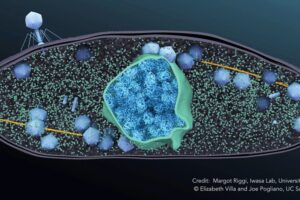
A jumbo phage infects a bacterium. A nucleus-like compartment (green) is formed to protect the newly synthesized phage genomes from bacterial defense systems. The capsids (gray) of the new phage travel along filaments called PhuZ (yellow) to be delivered to the nucleus where they dock in order to package phage DNA. Eventually, the bacterial cell lyses and the new phage emerge ready to infect new bacteria. Credit: Margot Riggi, Iwasa Lab, University of Utah. Copyright Elizabeth Villa and Joe Pogliano, UC San Diego

Therapeutic Potential of Bizarre ‘Jumbo’ Viruses Tapped for $10M HHMI Emerging Pathogens Project

Substack subscription form sign up

Comments

  • Not Buying Yer Bullshit on More Than a Third of Americans Have Lost Relationships Over Politics
  • Marco Messina on More Than a Third of Americans Have Lost Relationships Over Politics
  • Anon on Why Fructose Behaves Less Like a Calorie and More Like a Hormone
  • Mark Mellinger on Living Plastic Can Self-Destruct on Command
  • Marie Feret on The Silent Frequency That Makes Old Buildings Feel Haunted
© 2026 ScienceBlog.com | Follow our RSS / XML feed