Skip to content
ScienceBlog.com
  • Featured Blogs
    • EU Horizon Blog
    • ESA Tracker
    • Experimental Frontiers
    • Josh Mitteldorf’s Aging Matters
    • Dr. Lu Zhang’s Gondwanaland
    • NeuroEdge
    • NIAAA
    • SciChi
    • The Poetry of Science
    • Wild Science
  • Topics
    • Brain & Behavior
    • Earth, Energy & Environment
    • Health
    • Life & Non-humans
    • Physics & Mathematics
    • Social Sciences
    • Space
    • Technology
  • Our Substack
  • Follow Us!
    • Bluesky
    • Threads
    • FaceBook
    • Google News
    • Twitter/X
  • Contribute/Contact

environmental conservation

A native oyster bed on an urbanised coast.

The ocean is becoming too loud for oysters

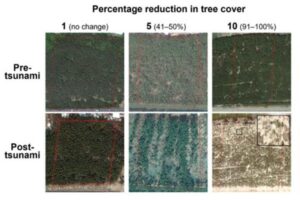
The upper panel depicts the coastal forest pre-tsunami, while the lower panel illustrates the forest post-tsunami. Each column represents the percentage decrease in coastal tree cover resulting from the tsunami event (1: no change, 5: 41-50%, 10: 91-100%). In cases where there was a 91-100% decrease in tree cover, indicated by the inset with the black frame in the bottom right image, nearly all trees were toppled by the tsunami. It is important to note that we magnified the satellite images/aerial photographs to assess the percentage decrease in coastal forest cover attributable to the tsunami event.

Mixed forests protect coastal areas from tsunami impacts better than monoculture forests

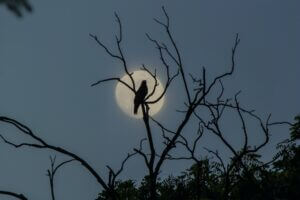
Bird at night. Unsplash

Artificial light is luring birds to cities and sometimes to their deaths

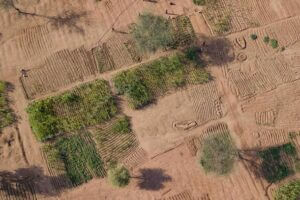
Five consecutive rainfall season failures in the Horn of Africa caused the region’s worst drought in 40 years (with Ethiopia, Kenya and Somalia particularly hard hit), contributing to reduced agricultural productivity, food insecurity and high food prices (WMO, 2023)

Drought data shows “an unprecedented emergency on a planetary scale”

Coral reef islands are losing the battle with sea-level rise, as exemplified by Beneamina, Solomon Islands, in the Pacific Ocean. Photo by Simon Albert.

World’s coastal wetlands and coral reef islands are hanging by a thread, new study shows

Air pollution

Millions of carbon credits are generated by overestimating forest preservation

Soil with CO2 bubbles coming off of it

Project Examines Key Role Soils Play in Keeping the Planet Cool

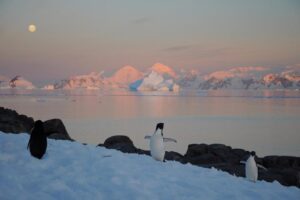
Penguins and a seal on the Antarctic Peninsula

Antarctic extremes ‘virtually certain’ as world warms

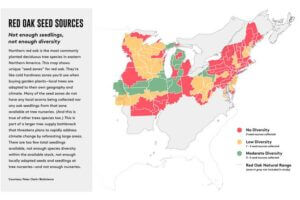
This map of red oak seed sources provides an example of a major threat to an important effort against climate change: major government and private funding is being invested in planting trees as a powerful tool to fight local and global warming. But new research in the journal Bioscience, from which this map is adapted, shows a troubling bottleneck that could threaten these efforts: U.S. tree nurseries don’t grow close to enough trees—nor have the species diversity needed—to meet ambitious planting goals.

Plans to plant billions of trees threatened by massive undersupply of seedlings

Ohio State logo

In Florida, endangered coral finds a way to blossom

Mighty oceans and humble ponds play key roles in biodiversity

Dr Imogen Napper, Research Fellow at the University of Plymouth

Scientists call for global push to eliminate space junk

Wetland

Small isolated wetlands are pollution-catching powerhouses

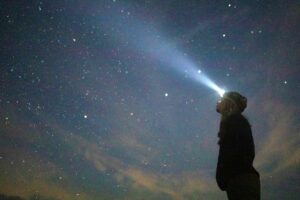
A startling analysis from Globe at Night — a citizen science program run by NSF’s NOIRLab — concludes that stars are disappearing from human sight at an astonishing rate. The study finds that, to human eyes, artificial lighting has dulled the night sky more rapidly than indicated by satellite measurements. The study showcases the unique contributions that citizen scientists can make in essential fields of research. This graphic illustrates how the greater the amount of light pollution, and therefore skyglow, the fewer the stars that are visible.

Stars disappear before our eyes, citizen scientists report

Older posts
Page1 Page2 Next →
Substack subscription form sign up

Comments

  • Karoly Mirnics on Common Prescription Drugs May Disrupt Cholesterol Pathways in the Womb and Raise Autism Risk
  • Aizen on Laziness helped lead to extinction of Homo erectus
  • Norwood johnson on Electrons in New Crystals Behave as If They Live in Four Dimensions
  • ScienceBlog.com on Hidden Geometry Could Finally Fix Quantum Computers
  • Theo Prinse on America Is Going Back to the Moon. This Time, It Plans to Stay
© 2026 ScienceBlog.com | Follow our RSS / XML feed