Skip to content
ScienceBlog.com
  • Featured Blogs
    • EU Horizon Blog
    • ESA Tracker
    • Experimental Frontiers
    • Josh Mitteldorf’s Aging Matters
    • Dr. Lu Zhang’s Gondwanaland
    • NeuroEdge
    • NIAAA
    • SciChi
    • The Poetry of Science
    • Wild Science
  • Topics
    • Brain & Behavior
    • Earth, Energy & Environment
    • Health
    • Life & Non-humans
    • Physics & Mathematics
    • Social Sciences
    • Space
    • Technology
  • Our Substack
  • Follow Us!
    • Bluesky
    • Threads
    • FaceBook
    • Google News
    • Twitter/X
  • Contribute/Contact

Europa

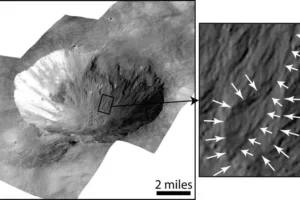
This image of the Cornelia Crater on Vesta shows lobate deposits (right) and curvilinear gullies (highlighted by the short white arrows, left). According to a newly published paper in The Planetary Science Journal, ice underneath the surface of an airless world could be excavated and melted by an impact, such as from a meteoroid impact, and then flow along the walls of the impact crater as liquid brines to form these distinct surface features.

New Study Sheds Light on Mysterious Surface Features of Airless Worlds

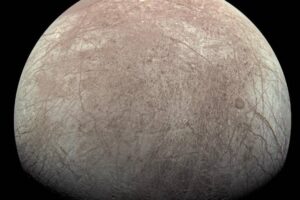
This view of Jupiter’s icy moon Europa was captured by the JunoCam imager aboard NASA’s Juno spacecraft during the mission’s close flyby on Sept. 29, 2022. Credit: Image data: NASA/JPL-Caltech/SwRI/MSSS Image processing: Kevin M. Gill CC BY 3.0 Full Image Details

NASA’s Juno Mission Measures Oxygen Production at Europa

Substack subscription form sign up

Comments

  • Karoly Mirnics on Common Prescription Drugs May Disrupt Cholesterol Pathways in the Womb and Raise Autism Risk
  • Aizen on Laziness helped lead to extinction of Homo erectus
  • Norwood johnson on Electrons in New Crystals Behave as If They Live in Four Dimensions
  • ScienceBlog.com on Hidden Geometry Could Finally Fix Quantum Computers
  • Theo Prinse on America Is Going Back to the Moon. This Time, It Plans to Stay
© 2026 ScienceBlog.com | Follow our RSS / XML feed