Skip to content
ScienceBlog.com
  • Featured Blogs
    • EU Horizon Blog
    • ESA Tracker
    • Experimental Frontiers
    • Josh Mitteldorf’s Aging Matters
    • Dr. Lu Zhang’s Gondwanaland
    • NeuroEdge
    • NIAAA
    • SciChi
    • The Poetry of Science
    • Wild Science
  • Topics
    • Brain & Behavior
    • Earth, Energy & Environment
    • Health
    • Life & Non-humans
    • Physics & Mathematics
    • Social Sciences
    • Space
    • Technology
  • Our Substack
  • Follow Us!
    • Bluesky
    • Threads
    • FaceBook
    • Google News
    • Twitter/X
  • Contribute/Contact

extraterrestrial life

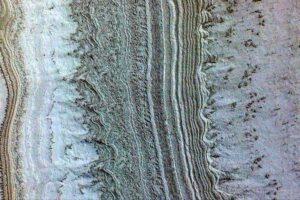
This image taken by NASA’s Mars Reconnaissance Orbiter shows ice sheets at Mars’ south pole.

Mars Ice Deposits May Harbor Potential for Microbial Life

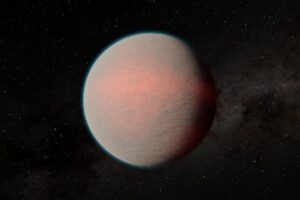
Magma ocean planets that contain water – like the earthlike exoplanet GJ 1214 b in this artist’s concept – will only host a tiny fraction of this water on their surface. The majority of it is stored deep in their interiors.

Planets Harbor More Water Than Previously Thought, Study Reveals

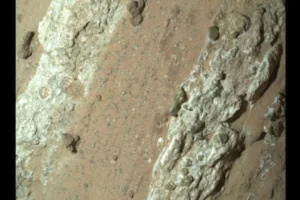
In July 2024, NASA's Perseverance rover found "leopard spots" on a reddish rock called "Cheyava Falls" in Mars' Jezero Crater. Scientists suggest these spots might indicate that chemical reactions in the rock billions of years ago could have supported microbial life. Other explanations are also being explored.

Perseverance Rover Uncovers Intriguing Rock on Mars with Potential Signs of Ancient Life

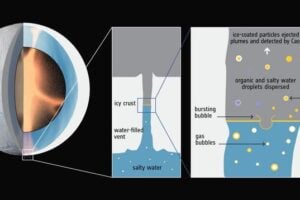
The drawing on the left depicts Enceladus and its ice-covered ocean, with cracks near the south pole that are believed to penetrate through the icy crust. The middle panel shows where authors believe life could thrive: at the top of the water, in a proposed thin layer (shown yellow) like on Earth’s oceans. The right panel shows that as gas bubbles rise and pop, bacterial cells could get lofted into space with droplets that then become the ice grains that were detected by Cassini.

New Study Reveals Potential for Detecting Life on Icy Moons of Saturn and Jupiter

Ohio State logo

Researchers spying for signs of life among exoplanet atmospheres

Artwork f alien assembly line

Is oxygen the cosmic key to alien technology?

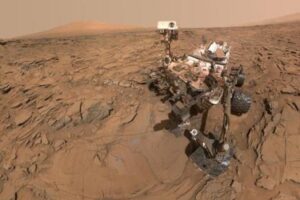
Image: A selfie, taken by the Curiosity rover on the surface of Mars in June 2016. The Curiosity rover used the pyrolysis-GCMS equipment described in this notice (Secondary Creator Credit: NASA/JPL-Caltech/MSSS).

Scientists develop AI method to identify life on other worlds

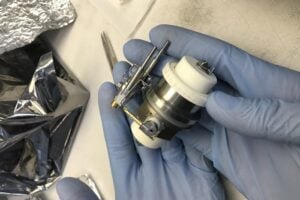
This small laser device can help detect signs of life on other planets

Small laser device can help detect signs of life on other planets

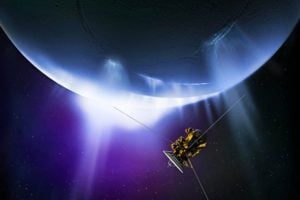
Artist's impression of the Cassini spacecraft flying through plumes erupting from the south pole of Saturn's moon Enceladus. These plumes are much like geysers and expel a combination of water vapor, ice grains, salts, methane and other organic molecules.

What it would take to discover life on Saturn’s icy moon Enceladus

Substack subscription form sign up

Comments

  • brenojames on Global warming reduces available wind energy
  • Kidreadytobreed on Global warming reduces available wind energy
  • James on Global warming reduces available wind energy
  • James on Global warming reduces available wind energy
  • Booklet AI on Key to online education: Test early and often
© 2026 ScienceBlog.com | Follow our RSS / XML feed