Skip to content
ScienceBlog.com
  • Featured Blogs
    • EU Horizon Blog
    • ESA Tracker
    • Experimental Frontiers
    • Josh Mitteldorf’s Aging Matters
    • Dr. Lu Zhang’s Gondwanaland
    • NeuroEdge
    • NIAAA
    • SciChi
    • The Poetry of Science
    • Wild Science
  • Topics
    • Brain & Behavior
    • Earth, Energy & Environment
    • Health
    • Life & Non-humans
    • Physics & Mathematics
    • Social Sciences
    • Space
    • Technology
  • Our Substack
  • Follow Us!
    • Bluesky
    • Threads
    • FaceBook
    • Google News
    • Twitter/X
  • Contribute/Contact

Fatty Acids

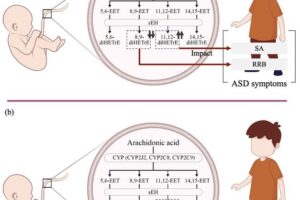
Arachidonic acid, which is released from phospholipid membranes, is metabolized to various epoxyeicosatrienoic acid (EET) compounds and subsequently to dihydroxyeicosatrienoic acids (diHETrE). This study revealed that high levels of 11,12- diHETrE in umbilical cord blood are associated with ASD symptoms, such as social affect (SA) and adaptive functioning. Additionally, lower levels of 8,9-diHETrE impacted repetitive/restrictive behaviors (RRB).

Fatty acids in umbilical cord blood might cause autism spectrum disorder

Dr Isaac Akefe and Professor Frederic Meunier in a QBI laboratory.

Fatty acids hold clue to creating memories

Ohio State logo

Saturated fat may interfere with creating memories in aged brain

Substack subscription form sign up

Comments

  • Norwood johnson on Electrons in New Crystals Behave as If They Live in Four Dimensions
  • ScienceBlog.com on Hidden Geometry Could Finally Fix Quantum Computers
  • Theo Prinse on America Is Going Back to the Moon. This Time, It Plans to Stay
  • george w on Hidden Geometry Could Finally Fix Quantum Computers
  • Tom Hughes on Years of Exercise, Blood Pressure Drugs Failed to Slow Cognitive Decline in Seniors at Dementia Risk
© 2026 ScienceBlog.com | Follow our RSS / XML feed