Skip to content
ScienceBlog.com
  • Featured Blogs
    • EU Horizon Blog
    • ESA Tracker
    • Experimental Frontiers
    • Josh Mitteldorf’s Aging Matters
    • Dr. Lu Zhang’s Gondwanaland
    • NeuroEdge
    • NIAAA
    • SciChi
    • The Poetry of Science
    • Wild Science
  • Topics
    • Brain & Behavior
    • Earth, Energy & Environment
    • Health
    • Life & Non-humans
    • Physics & Mathematics
    • Social Sciences
    • Space
    • Technology
  • Our Substack
  • Follow Us!
    • Bluesky
    • Threads
    • FaceBook
    • Google News
    • Twitter/X
  • Contribute/Contact

Flexible electronics

Individual silk protein molecules, or “silk fibroins” (blue), are deposited on a graphene surface surrounded by water (green and red spheres) and grow into an atomically precise two-dimensional (2D) sheet. Controlled deposition of silk fibers could lead to numerous biodegradable electronic devices.

Silk and Graphene Fusion: A New Era for Flexible Electronics

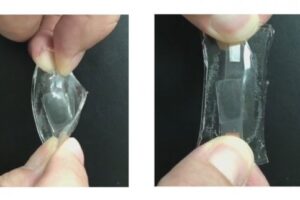
This lithium-ion battery has entirely stretchable components and stable charging and discharging capacity over time.

Completely stretchy lithium-ion battery for flexible electronics

Illustration of spinal cord

Flexible, Robotic Nerve ‘Cuffs’ Offer Potential for Minimally Invasive Monitoring and Treatment of Neurological Conditions

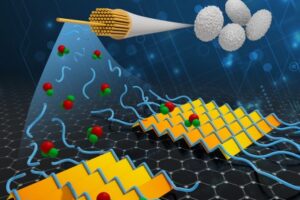
This flexible and conductive material has “adaptive durability,” meaning it gets stronger when hit.

Hitting this stretchy, electronic material makes it tougher

Substack subscription form sign up

Comments

  • Norwood johnson on Electrons in New Crystals Behave as If They Live in Four Dimensions
  • ScienceBlog.com on Hidden Geometry Could Finally Fix Quantum Computers
  • Theo Prinse on America Is Going Back to the Moon. This Time, It Plans to Stay
  • george w on Hidden Geometry Could Finally Fix Quantum Computers
  • Tom Hughes on Years of Exercise, Blood Pressure Drugs Failed to Slow Cognitive Decline in Seniors at Dementia Risk
© 2026 ScienceBlog.com | Follow our RSS / XML feed