Skip to content
ScienceBlog.com
  • Featured Blogs
    • EU Horizon Blog
    • ESA Tracker
    • Experimental Frontiers
    • Josh Mitteldorf’s Aging Matters
    • Dr. Lu Zhang’s Gondwanaland
    • NeuroEdge
    • NIAAA
    • SciChi
    • The Poetry of Science
    • Wild Science
  • Topics
    • Brain & Behavior
    • Earth, Energy & Environment
    • Health
    • Life & Non-humans
    • Physics & Mathematics
    • Social Sciences
    • Space
    • Technology
  • Our Substack
  • Follow Us!
    • Bluesky
    • Threads
    • FaceBook
    • Google News
    • Twitter/X
  • Contribute/Contact

Fossils

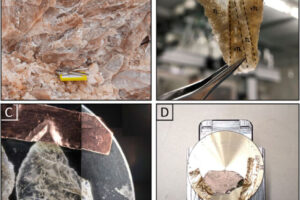
Gypsum’s crystalline facies and sample handling. Images of the studied twinned selenite crystal and of the sample preparation and handling for optical microscopy, SEM-EDX, and LIMS analyses. (A) Smal crystal selenite (SC) and decimeter-sized twinned arrow-head selenite (TS) crystals show the darker re-entrant angle of the crystals (dashed black lines). (B) Large petrographic thin section of the re-entrant angle of the twinned selenite crystal marked in the blue rectangle in (A). It shows very turbid (vTL), turbid (TL) and limpid laminations (LL). (C) Small petrographic thin section of turbid laminae fixed on the LIMS sample holder with copper tape. (D) Gold coated sample on the LIMS sample holder.

Laser-powered device tested on Earth could spot microbial fossils on Mars

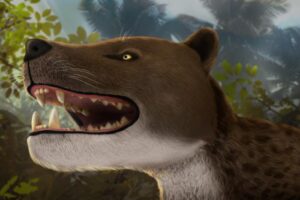
Artwork of how Bastetodon likely appeared.

Near-complete skull discovery reveals ‘top apex’, leopard-sized “fearsome” carnivore

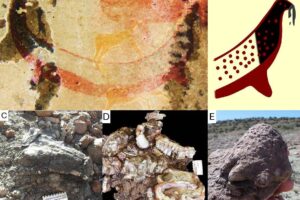
A, Photo of the tusked animal of the Horned Serpent panel. B, interpretive drawing of its head. C, skull of a Lystrosaurus (14-03-2024, Oviston Nature Reserve) showing the prominent tusks, photographed in situ at the moment of its discovery, before excavation, and unprepared. D, complete skeleton of a Lystrosaurus (BP/1/9100, Oviston Nature Reserve) with its vertebral column curved into an opisthotonic "death pose", ex situ, prepared. E, the ‘mummified’ foot of a Lystrosaurus (28-08-2022, Fairydale, Bethulie District) showing the warty aspect of its preserved skin, ex situ, unprepared.

Ancient Rock Art May Depict Extinct Species, Predating Scientific Discovery

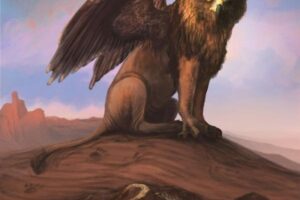
griffin

Dinosaur-Griffin Connection Debunked: New Study Challenges Popular Myth

Reconstruction of the earliest sea-going reptile from the Southern Hemisphere: Nothosaurs swimming along the ancient southern polar coast, now part of New Zealand, around 246 million years ago. Artwork by Stavros Kundromichalis.

Ancient Sea Reptile Fossil Discovered in New Zealand Rewrites Evolutionary History

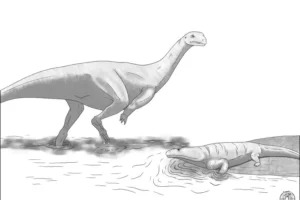
Artist reconstruction of Musankwa sanyatiensis, walking in Triassic shallow waters past a metoposaur.

New Dinosaur Species Discovered on the Shores of Lake Kariba in Zimbabwe

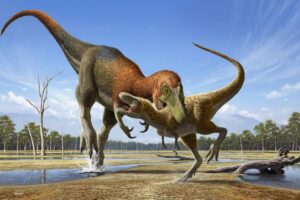
Artist illustration of Nanotyrannus attacking a juvenile T. rex.

“Juvenile T. rex” fossils are a distinct species of small tyrannosaur

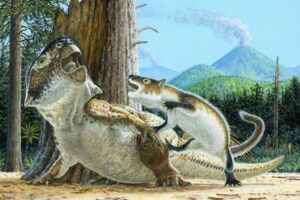
Illustration showing Repenomamus robustus as it attacks Psittacosaurus lujiatunensis moments before a volcanic debris flow buries them both, ca. 125 million years ago.

Unusual fossil shows rare evidence of a mammal attacking a dinosaur

Bone cavities called air sacs appeared in the ancestors of long-necked dinosaurs about 225 million years ago, according to the analysis of a specimen found in Rio Grande do Sul state, South Brazil. The study also shows that air sacs did not evolve as linearly as scientists believe (credit: Márcio L. Castro)

Brazilian fossil provides earliest evidence of evolutionary trait that enabled dinosaurs to become giants

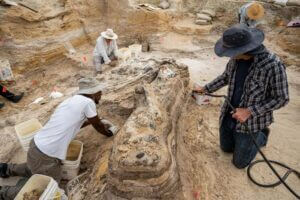
Researchers and volunteers with the Florida Museum of Natural History have discovered the ancient remains of several gomphotheres at a fossil site in North Florida.

Paleontologists discover elephant graveyard in North Florida

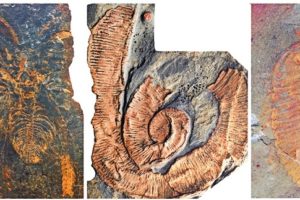
Fossils from the Fezouata Shale. From left to right, a non-mineralized arthropod (Marrellomorpha), a palaeoscolecid worm and a trilobites

Giant arthropods dominated the seas 470 million years ago

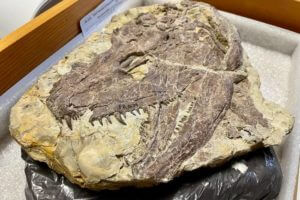
A Whatcheeria skull in the collections of the Field Museum, with its many sharp teeth visible

Ancient superpredator got big by front-loading its growth in its youth

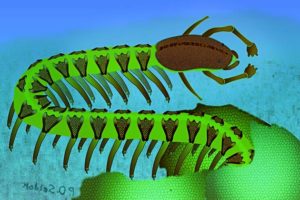
Artist's impression of an individual 525-million-year-old Cardiodictyon catenulum on the shallow coastal sea floor, emerging from the shelter of a small stromatolite built by photosynthetic bacteria.

525-million-year-old fossil defies textbook explanation for brain evolution

Substack subscription form sign up

Comments

  • Brunette Keller on How New Herpes Drugs Jam a Virus’s Replication Engine
  • Aizen on Laziness helped lead to extinction of Homo erectus
  • Norwood johnson on Electrons in New Crystals Behave as If They Live in Four Dimensions
  • ScienceBlog.com on Hidden Geometry Could Finally Fix Quantum Computers
  • Theo Prinse on America Is Going Back to the Moon. This Time, It Plans to Stay
© 2026 ScienceBlog.com | Follow our RSS / XML feed