Skip to content
ScienceBlog.com
  • Featured Blogs
    • EU Horizon Blog
    • ESA Tracker
    • Experimental Frontiers
    • Josh Mitteldorf’s Aging Matters
    • Dr. Lu Zhang’s Gondwanaland
    • NeuroEdge
    • NIAAA
    • SciChi
    • The Poetry of Science
    • Wild Science
  • Topics
    • Brain & Behavior
    • Earth, Energy & Environment
    • Health
    • Life & Non-humans
    • Physics & Mathematics
    • Social Sciences
    • Space
    • Technology
  • Our Substack
  • Follow Us!
    • Bluesky
    • Threads
    • FaceBook
    • Google News
    • Twitter/X
  • Contribute/Contact

galactic collisions

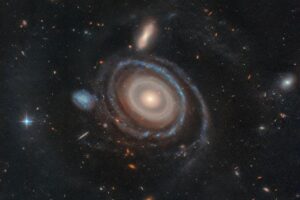
LEDA 1313424, aptly nicknamed the Bullseye, is two and a half times the size of our Milky Way and has nine rings — six more than any other known galaxy. High-resolution imagery from NASA’s Hubble Space Telescope confirmed eight rings, and data from the W. M. Keck Observatory in Hawaii confirmed a ninth. Hubble and Keck also confirmed which galaxy dove through the Bullseye, creating these rings: the blue dwarf galaxy that sits to its immediate center-left.

Cosmic Bull’s-Eye: Monster Galaxy’s Nine Rings Reveal Epic Space Collision

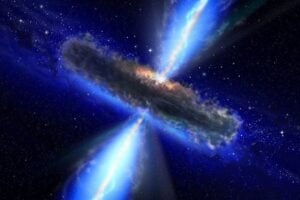
Galactic collision course triggers black hole bursts

Galactic collision course triggers black hole bursts
Substack subscription form sign up

Comments

  • Norwood johnson on Electrons in New Crystals Behave as If They Live in Four Dimensions
  • ScienceBlog.com on Hidden Geometry Could Finally Fix Quantum Computers
  • Theo Prinse on America Is Going Back to the Moon. This Time, It Plans to Stay
  • george w on Hidden Geometry Could Finally Fix Quantum Computers
  • Tom Hughes on Years of Exercise, Blood Pressure Drugs Failed to Slow Cognitive Decline in Seniors at Dementia Risk
© 2026 ScienceBlog.com | Follow our RSS / XML feed