Skip to content
ScienceBlog.com
  • Featured Blogs
    • EU Horizon Blog
    • ESA Tracker
    • Experimental Frontiers
    • Josh Mitteldorf’s Aging Matters
    • Dr. Lu Zhang’s Gondwanaland
    • NeuroEdge
    • NIAAA
    • SciChi
    • The Poetry of Science
    • Wild Science
  • Topics
    • Brain & Behavior
    • Earth, Energy & Environment
    • Health
    • Life & Non-humans
    • Physics & Mathematics
    • Social Sciences
    • Space
    • Technology
  • Our Substack
  • Follow Us!
    • Bluesky
    • Threads
    • FaceBook
    • Google News
    • Twitter/X
  • Contribute/Contact

Galaxy Clusters

galaxy seen from the side

New AI Distinguishes Dark Matter from Cosmic Interference

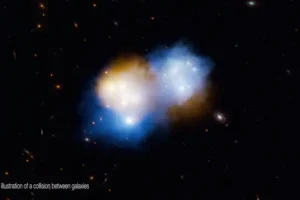
This artist's concept shows what happened when two massive clusters of galaxies, collectively known as MACS J0018.5, collided: The dark matter in the galaxy clusters (blue) sailed ahead of the associated clouds of hot gas, or normal matter (orange). Both dark matter and normal matter feel the pull of gravity, but only the normal matter experiences additional effects like shocks and turbulence that slow it down during collisions.

Dark matter flies ahead of normal matter in mega galaxy cluster collision

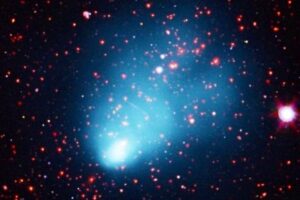
Composite colour image of the interacting galaxy cluster El Gordo, showing X-ray light from NASA's Chandra X-ray Observatory in blue, optical data from the European Southern Observatory's Very Large Telescope in red, green, and blue, and infrared emission from NASA's Spitzer Space Telescope in red and orange.

Study Suggests Dark Matter May Be Self-Interacting in Massive Galaxy Cluster Collisions

Composite colour image of the interacting galaxy cluster El Gordo, showing X-ray light from NASA's Chandra X-ray Observatory in blue, optical data from the European Southern Observatory's Very Large Telescope in red, green, and blue, and infrared emission from NASA's Spitzer Space Telescope in red and orange.

Titanic galaxy cluster collision in the early Universe challenges standard cosmology

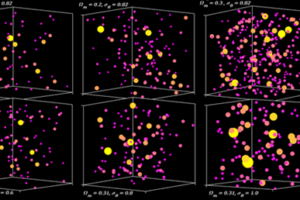
Like Goldilocks, the team compared the number of galaxy clusters measured with predictions from numerical simulations to determine which answer was “just right.”

Matter comprises of 31% of the total amount of stuff in the universe

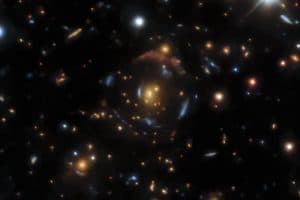
An example of a gravitational lens found in the DESI Legacy Surveys data. There are four sets of lensed images in DESI-090.9854-35.9683, corresponding to four distinct background galaxies — from the outermost giant red arc to the innermost bright blue arc, arranged in four concentric circles. All of them are gravitationally warped — or lensed — by the orange galaxy at the very center.

Astrophysicists show how to “weigh” galaxy clusters with artificial intelligence

Substack subscription form sign up

Comments

  • Dax on The Silent Frequency That Makes Old Buildings Feel Haunted
  • Karoly Mirnics on Common Prescription Drugs May Disrupt Cholesterol Pathways in the Womb and Raise Autism Risk
  • Aizen on Laziness helped lead to extinction of Homo erectus
  • Norwood johnson on Electrons in New Crystals Behave as If They Live in Four Dimensions
  • ScienceBlog.com on Hidden Geometry Could Finally Fix Quantum Computers
© 2026 ScienceBlog.com | Follow our RSS / XML feed