Skip to content
ScienceBlog.com
  • Featured Blogs
    • EU Horizon Blog
    • ESA Tracker
    • Experimental Frontiers
    • Josh Mitteldorf’s Aging Matters
    • Dr. Lu Zhang’s Gondwanaland
    • NeuroEdge
    • NIAAA
    • SciChi
    • The Poetry of Science
    • Wild Science
  • Topics
    • Brain & Behavior
    • Earth, Energy & Environment
    • Health
    • Life & Non-humans
    • Physics & Mathematics
    • Social Sciences
    • Space
    • Technology
  • Our Substack
  • Follow Us!
    • Bluesky
    • Threads
    • FaceBook
    • Google News
    • Twitter/X
  • Contribute/Contact

Galaxy Formation

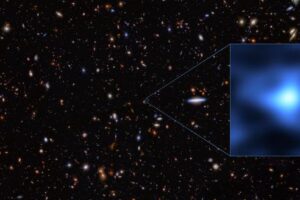
Three spectra taken by the JWST/NIRSpec superimposed on an image taken by the JWST/NIRCam, two instruments on board the James Webb Space Telescope. The record galaxy is shown in the middle. It appears in red in the image and its spectrum decreases towards the left (short wavelengths). For comparison, the spectra at the top and bottom, in blue and violet, show typical star-forming galaxies at a similar time in cosmic history.

Galaxies die earlier than expected

galaxy JADES-GS-z14-0

Oxygen Found in Universe’s Most Distant Galaxy Rewrites Stellar Timeline

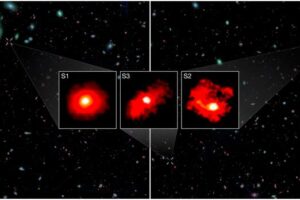
The three Red Monsters represent the core findings of this work – these extremely massive and dusty galaxies in the first billion years after the Big Bang indicate that the early Universe is forming stars more efficiently than expected. Image taken by the James Webb Space Telescope.

Three Massive Ancient Galaxies Defy Laws of Star Formation

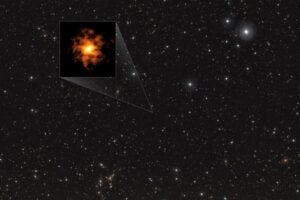
This image shows the galaxy REBELS-25 as seen by the Atacama Large Millimeter/submillimeter Array (ALMA), overlaid on an infrared image of other stars and galaxies. The infrared image was taken by ESO’s Visible and Infrared Survey Telescope for Astronomy (VISTA). In a recent study, researchers found evidence that REBELS-25 is a strongly rotating disc galaxy existing only 700 million years after the Big Bang. This makes it the most distant and earliest known Milky Way-like galaxy found to date.

Rebel Star: Ancient Galaxy Defies Time, Dances Like the Milky Way

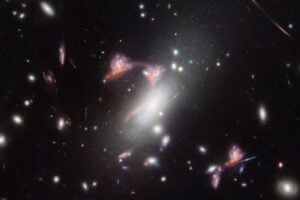
The galaxy cluster MACS-J0417.5-1154 is so massive that it bends the fabric of space-time. This causes the appearance of galaxies behind it to be distorted, an effect known as gravitational lensing. This natural phenomenon magnifies distant galaxies and can also make them appear in an image multiple times, as NASA's James Webb Space Telescope has observed. In this image, two distant, interacting galaxies - a face-on spiral and a dusty red galaxy seen from the side - appear multiple times, tracing a familiar shape across the sky. The fact that these galaxies are actively forming stars and that the face-on galaxy's spiral shape is remarkably intact indicates that their interaction is just beginning.

Webb Telescope Unveils Rare Cosmic ‘Question Mark’ in Distant Galaxy

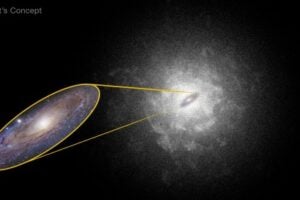
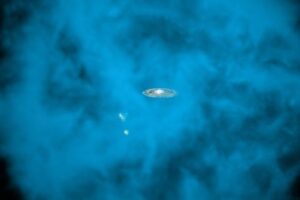
One of the few galaxies with a well-studied stellar halo is our neighbor, Andromeda, depicted here in the graphic. The reason Andromeda’s halo can be investigated so thoroughly is simply a matter of distance, both being close enough and bright enough that we can see the full picture with our current class of telescopes.

NASA’s Roman Space Telescope Set to Unveil Galactic History and Dark Matter Secrets

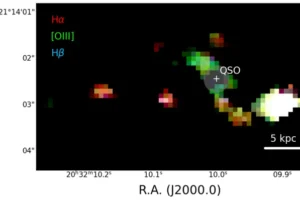
Here's a clearer version of the image caption: Colored map of the PJ308-21 system showing gas emissions: - Hydrogen: Red and blue - Oxygen: Green The central quasar's light has been masked out. Color variations in the quasar's host galaxy and its companions indicate different gas properties in each region.

Webb Space Telescope captures staggering quasar-galaxy merger in remote universe

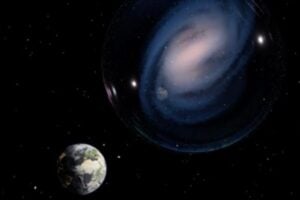
Artistic representation of the spiral barred galaxy ceers-2112, observed in the early universe. The Earth is reflected on an illusive bubble surrounding the galaxy, recalling the connection between the Milky Way and ceers-2112.

Milky Way-like galaxy found in the early universe

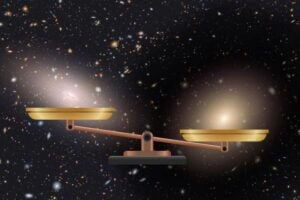
Comparison between a conventional galaxy (ESO 325-G004) enveloped in a halo of dark matter, occupying the heaviest plate on the weight scale, and the galaxy NGC 1277 (on the left), in which the study of the mass distribution reveals the absence of dark matter.

The puzzle of the galaxy with no dark matter

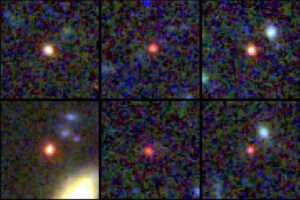
Images of six candidate massive galaxies, seen 500-800 million years after the Big Bang. Image credit: NASA/ESA/CSA/I. Labbe

Webb images challenge theories of how universe evolved

Pictured above: Artist's depiction of our Milky Way galaxy and its small galaxy companions surrounded by a giant halo of million-degree gas. Credit: NASA/CXC/M.Weiss/Ohio State/A Gupta et al

Milky Way’s Halo Surprisingly Empty

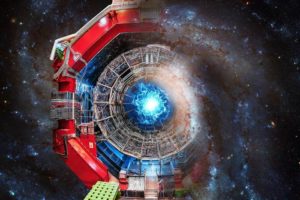
Illustration of antihelium annihilation in the ALICE detector at CERN as well as in the universe.

Anti-helium nuclei carry messages from the depths of the galaxy

Substack subscription form sign up

Comments

  • Karoly Mirnics on Common Prescription Drugs May Disrupt Cholesterol Pathways in the Womb and Raise Autism Risk
  • Aizen on Laziness helped lead to extinction of Homo erectus
  • Norwood johnson on Electrons in New Crystals Behave as If They Live in Four Dimensions
  • ScienceBlog.com on Hidden Geometry Could Finally Fix Quantum Computers
  • Theo Prinse on America Is Going Back to the Moon. This Time, It Plans to Stay
© 2026 ScienceBlog.com | Follow our RSS / XML feed