Skip to content
ScienceBlog.com
  • Featured Blogs
    • EU Horizon Blog
    • ESA Tracker
    • Experimental Frontiers
    • Josh Mitteldorf’s Aging Matters
    • Dr. Lu Zhang’s Gondwanaland
    • NeuroEdge
    • NIAAA
    • SciChi
    • The Poetry of Science
    • Wild Science
  • Topics
    • Brain & Behavior
    • Earth, Energy & Environment
    • Health
    • Life & Non-humans
    • Physics & Mathematics
    • Social Sciences
    • Space
    • Technology
  • Our Substack
  • Follow Us!
    • Bluesky
    • Threads
    • FaceBook
    • Google News
    • Twitter/X
  • Contribute/Contact

Gas Giants

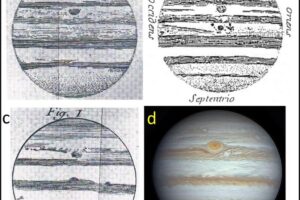
Illustrations by the 17th-century astronomer Cassini (a-c), compared with Jupiter's current Great Red Spot as captured by Eric Sussenbach in 2023.

Jupiter’s Great Red Spot Formed Less Than 200 Years Ago, Study Suggests

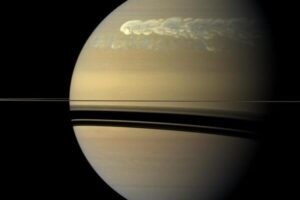
A huge storm dominates the rather featureless surface of Saturn in an image taken by the Cassini spacecraft on Feb. 25, 2011, about 12 weeks after the powerful storm was first detected in the planet's northern hemisphere. The megastorm is seen overtaking itself as it encircles the entire planet. Astronomers have found deep in the atmosphere the aftereffects of megastorms that occurred hundreds of years ago. The dark stripes are the shadows of Saturn's rings.

Hundred-year storms? That’s how long they last on Saturn.

Substack subscription form sign up

Comments

  • Sue Ann Hayes on Hidden Nuclear Protein Fuels Pancreatic Cancer’s Deadly Aggression
  • Curtis Webber on The GPS-Killer? This Quantum Device ‘Feels’ Motion Like a Brain—Down to the Atomic Level
  • Ran on How the Age You First Had Sex Could Shape How You Age Decades Later
  • Sparty on How the Age You First Had Sex Could Shape How You Age Decades Later
  • Josh Mitteldorf on A Single TV Segment Sent Leucovorin Prescriptions for Autistic Children Soaring 2,000 Percent
© 2026 ScienceBlog.com | Follow our RSS / XML feed