Skip to content
ScienceBlog.com
  • Featured Blogs
    • EU Horizon Blog
    • ESA Tracker
    • Experimental Frontiers
    • Josh Mitteldorf’s Aging Matters
    • Dr. Lu Zhang’s Gondwanaland
    • NeuroEdge
    • NIAAA
    • SciChi
    • The Poetry of Science
    • Wild Science
  • Topics
    • Brain & Behavior
    • Earth, Energy & Environment
    • Health
    • Life & Non-humans
    • Physics & Mathematics
    • Social Sciences
    • Space
    • Technology
  • Our Substack
  • Follow Us!
    • Bluesky
    • Threads
    • FaceBook
    • Google News
    • Twitter/X
  • Contribute/Contact

gene editing

Pathological phosphorylation (yellow) of Tau proteins (red-orange) leads to disintegration of microtubuli in the neuron axon an aggregation of the tau proteins. The transport of synaptic vesicles (orange-blue) is interrupted. Credit: selvanegra on iStock

Achilles’ Heel of Alzheimer’s: Scientists Pinpoint Crucial Protein Variant Driving Brain Cell Damage

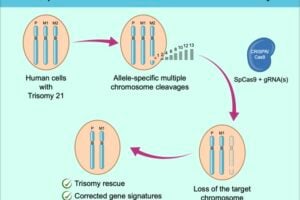
A graphical abstract summarizes the approach.

Using CRISPR to remove extra chromosomes in Down syndrome

Prof Pablo Perez-Pinera, center is joined by fellow researchers Shraddha Shirguppe, left, and Angelo Miskalis, right, in a research space at Everitt Lab. Photo taken at the University of Illinois Urbana-Champaign on Friday, Dec. 20, 2024. (Photo by Fred Zwicky / University of Illinois Urbana-Champaign)

Gene Editing Tool Shows Promise for Treating Alzheimer’s Disease

The CRISPR gene scissors can correct mutations in DNA very precisely. However, the treatment of genetic defects can lead to new errors in the genome that may pose health risks. (Image: iStock/luismmolina)

Scientists Uncover Hidden Risks in CRISPR Gene Editing for Rare Immune Disease

jason comander

CRISPR Gene Editing Shows Promise in Treating Inherited Blindness

Credit: Catherine Boush, Broad Communications

Researchers Engineer Multi-Tailed mRNA, Unlocking Potential for Longer-Lasting Gene Therapies

Retrotransposons found in the genomes of the white-throated sparrow and the zebra finch are shown to safely shepherd transgenes into the human genome, providing a gene therapy approach complementary to CRISPR-Cas9 gene editing.

Junk DNA in birds may hold key to safe, efficient gene therapy

gene illustration

Prime Editing Rescues Genetic Disorders in Living Animals Using Engineered, Virus-like Particles

Edward Hopper style illustration of a woman checking her cholesterol in a sparse hotel room

Gene-editing treatment could replace cholesterol meds

Embryo cells. Pixabay

Researchers warn on embryo editing

Brian Vander Ley poses with Ginger, the first gene-edited cow resistant to bovine viral diarrheal virus (BVDV).

Gene-edited super calf resistant to brutal virus

Illustration of human brain

How our brains turn into smarter disease fighters

Bowl of grapes, green and red

Consumers care more about taste than gene editing for table grapes

Substack subscription form sign up

Comments

  • Karoly Mirnics on Common Prescription Drugs May Disrupt Cholesterol Pathways in the Womb and Raise Autism Risk
  • Aizen on Laziness helped lead to extinction of Homo erectus
  • Norwood johnson on Electrons in New Crystals Behave as If They Live in Four Dimensions
  • ScienceBlog.com on Hidden Geometry Could Finally Fix Quantum Computers
  • Theo Prinse on America Is Going Back to the Moon. This Time, It Plans to Stay
© 2026 ScienceBlog.com | Follow our RSS / XML feed